5 Of The Biggest Drawbacks Of Micro LED TVs
You might’ve heard Micro LED described as the future of television technology. That’s not a label that’s thrown around for just any type of display. On paper, the format sounds almost impossible to beat: Like OLED, every pixel gets its own light, giving you some of the best contrast and deep black levels in the biz. Unlike OLED, however, Micro LED relies on tiny inorganic LEDs instead of organic compounds. Theoretically, that means higher brightness, longer lifespan, and improved durability over the already excellent performance of OLED.
Yet despite all that promise, Micro LED probably isn’t going to be found in most mainstream living rooms. Years after major manufacturers first debuted the technology, most consumers still aren’t buying them. Even companies actively developing the technology will tell you: These things might not even catch on for another five years or more. Why? Well, as it turns out, there are a handful of major drawbacks to Micro LED TVs. Even for all its strengths, these five things are holding Micro LEDs back.
They’re extremely expensive
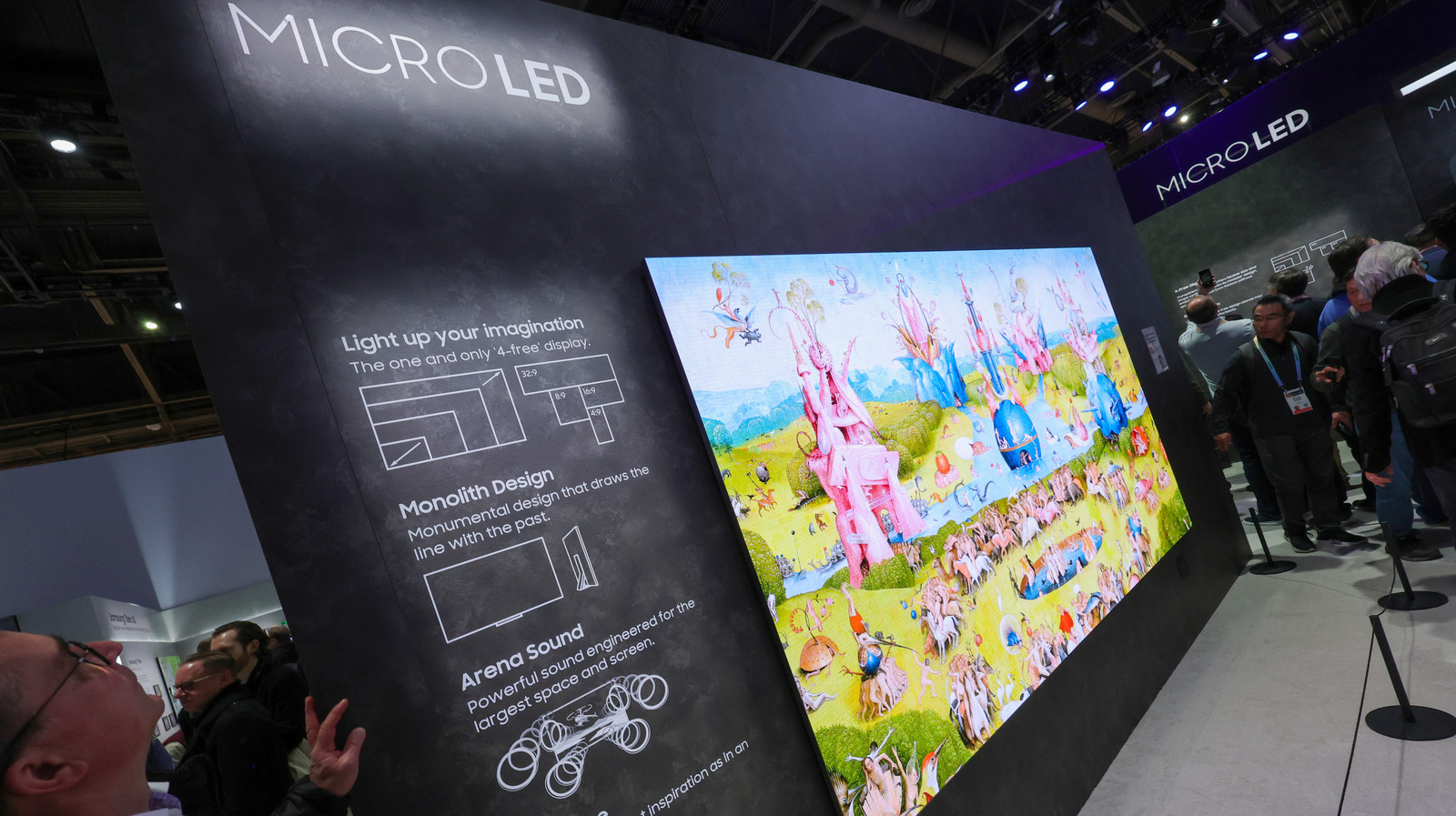
The single biggest drawback of Micro LED TVs is their price. Unlike most television tech (which, historically, gets more affordable as manufacturing scales up), Micro LED is a long way off from reaching a practical price point for average buyers. Today, most Micro LED models rest firmly in luxury territory. Depending on the size, it’s not unheard of to see a five-figure price tag for one of these — and in extreme cases, like Samsung’s 89-inch Micro LED TV, that price can go as high as six figures.
Unfortunately, it seems like the cost is intrinsically tied to the way Micro LEDs are made right now. Every individual pixel contains three Micro LED subpixels: one red, one green, and one blue… all of which must be manufactured separately before being perfectly aligned during assembly. To put things into perspective, a single 4K television needs roughly 25 million individual LEDs. And of those 25 million, they all have to be positioned just right or else they risk throwing off the whole display. Producing that many microscopic components without defects is an enormous engineering challenge that keeps production costs exceptionally high.
Difficult assembly means defects are common
That price point is proof: Manufacturing Micro LED displays is a lot more complicated than building a standard Panasonic TV or any other conventional television. But that complexity creates another major drawback in the form of production defects. Unlike LCD TVs that rely on backlighting for brightness and color accuracy, Micro LED uses millions of individually lit LEDs that each have to be positioned with expert precision.
Just think about all the moving parts that go into putting just one Micro LED TV together: all those millions of microscopic LEDs are often manufactured by a number of different suppliers before being brought together into one finished display. With so many separate components, it can be difficult to get it just right. Naturally, this opens the door to a bunch of little issues. Even one pixel out of line per row can add up to a noticeable defect. And as we mentioned above, every red, green, and blue subpixel has to line up perfectly, or else the whole thing is shot.
Color and brightness can be inconsistent
When made right, Micro LED TVs have exceptional picture quality. But the technology also comes with some unique image calibration challenges. Even when things seem to be working as they should, you could easily end up with a really weird-looking display.
The issue comes from the way Micro LED TVs display images in the first place. Every pixel is responsible for producing both its own color and its own brightness. Adjusting one inevitably influences the other, which can make fine-tuning the display much more complicated than with other TV display types. Maintaining consistent brightness without unintentionally messing with color (or vice versa, getting accurate colors without messing with brightness) can be tough, to say the least.
It can happen even without you touching any of the settings, too. Some people have run into viewing issues once the TV is in use, thanks (or no thanks) to the aforementioned troubles that can arise on the manufacturing side.
Easy to confuse with Mini-LED
One Micro LED TV drawback has nothing to do with the technology and everything to do with the name. Shopping for a television, you’re going to run into a bunch of different display types that have really similar-sounding names. The two that are most likely to give people the most trouble are Micro LED and Mini-LED. Despite how they sound, they aren’t the same.
Mini-LED television displays are ultimately just LCDs at their core… they just use thousands of miniature LEDs as a glorified backlighting system. Micro LED, by comparison, is a self-emissive technology where each and every individual pixel acts as its own light source. In reality, it’s more like an OLED than an LCD. (Though OLED is still a completely different thing. More on that in a sec.)
Imagine: someone could accidentally buy a Micro LED when they really wanted a Mini-LED and end up paying a lot more than they budgeted… not to mention receiving a totally different type of TV. Micro LED is the more premium television technology of the two, while Mini-LED has actually gotten pretty inexpensive comparatively.
OLED TVs are still the better value for most buyers
Perhaps the biggest drawback of Micro LED TVs today is that, despite their enormous potential, they still struggle to offer a compelling reason for most buyers to choose them over OLED. Upon its debut, the industry talked about Micro LED as the eventual successor to OLED. It gives you OLED’s perfect pixel-level contrast, avoids OLED’s burn-in concerns, and even comes with higher brightness and potentially greater color accuracy than OLED. But the problem is that, years later, “eventually” hasn’t arrived yet.
Modern OLED technology continues to improve at a rapid pace. Continued improvements to WOLED and QD-OLED TVs have pushed OLED’s brightness higher, all while maintaining the same exceptional black levels and contrast that made the technology famous. OLED TVs have also become significantly more affordable and much more widely available than Micro LED TVs. You could probably put together a whole home theater setup built around an OLED television for the price of a single Micro LED display alone.