Why Conventional Wisdom Says To Set Air Conditioners At 78 Degrees In A Heat Wave (And Why You Might Not Want To)
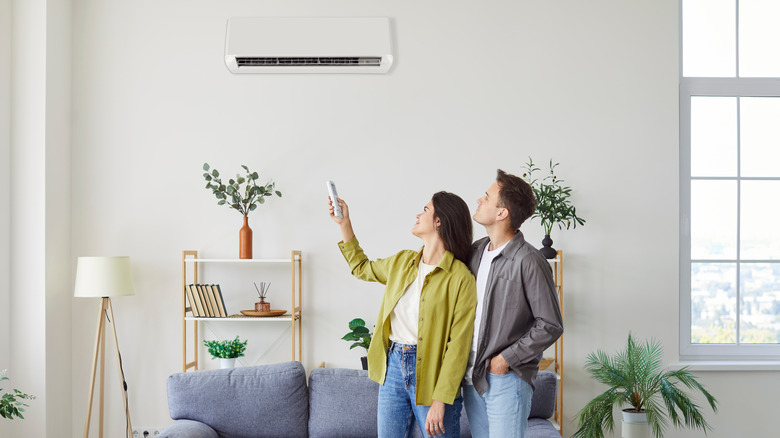
Heat waves seem to only be getting more frequent and intense as time goes on, and it’s positively brutal to endure them directly. Thankfully, home air conditioning systems can take the edge off, though running the AC at full blast all day isn’t exactly great for your power bill. Using a good budget-friendly air conditioner can help, but if you were to ask an expert on the matter, the typical recommendation would be to set your AC to 78 degrees for an optimal middle ground of comfort and energy efficiency. This, however, is not a one-size-fits-all solution.
Due to the way both standalone air conditioners and central air systems work, 78 degrees can generally stave off the worst effects of a heat wave pushing nearly 100 degrees. However, the crucial factor here isn’t just whether or not you’re feeling unpleasantly hot and sweaty; it’s whether everyone in your household is of a particular disposition of health to withstand even slightly above-average temperatures. If you live with elderly family members or very young children, as well as those with specific health conditions, you may need to accept the higher energy cost and set the AC a little bit lower.
78 degrees is considered a good balance of cooling and energy usage
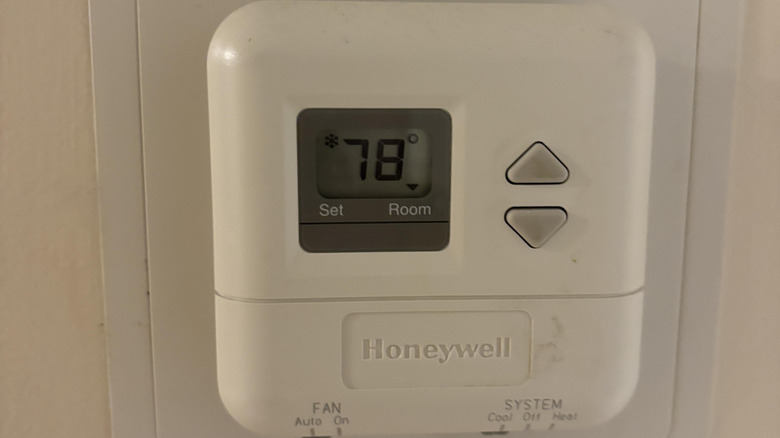
Most air conditioners are typically designed to keep the inside of your home, or whatever’s in their immediate vicinity in the case of standalone models, approximately 20 degrees cooler than whatever the temperature is outside. So, for example, if it’s a scorching 100 degrees outside, your air conditioner can help get that down to about 80 degrees. Of course, 80 degrees is still unpleasantly hot, so going a couple of notches lower than that can take the edge off.
This is why experts frequently recommend keeping your AC at 78 degrees during a heat wave. Keeping the temperature close to that 20-degree threshold reduces the frequency and intensity with which the AC operates, which helps keep energy costs down. This little quirk of AC operation is also known as the 20-degree rule. Going just a couple of notches lower than the threshold won’t increase that frequency or intensity much, and for a lot of people, 78 degrees, while not exactly chilly, is enough to keep things sufficiently comfortable.
Health conditions may necessitate lower temperatures
If keeping your air conditioner at 78 degrees works for you and everyone else in your home, great, you can leave it there for the duration of the summer. Unfortunately, life is rarely so accommodating. Everyone has different standards when it comes to comfortable temperatures; some people are fine with things being warm, while others can’t rest without a pleasant chill. Sticking to 78 might help keep the costs down, but if everyone is still miserable, it kind of defeats the purpose.
More pressingly, some people genuinely cannot handle higher temperatures from a health perspective. This includes very young children, elderly people, or those with certain chronic health conditions like heart issues, diabetes, or anything else that impacts one’s ability to sweat, stay hydrated, and generally regulate their own body temperature. Even if you’re doing okay at 78 degrees, someone else in your household may be quietly suffering.
The best course of action here, rather than using the 78-degree setting as an absolute rule, is to use it as a guideline. When the heat becomes overbearing, set the thermostat to 78 and stay up to date with everyone in your house. If anyone is showing signs of heat stress, start gradually turning the temperature down further, one degree at a time, until everyone’s comfortable. Maybe you’ll spend a little more than you’d like on power bills, but everyone’s health and safety are paramount. If necessary, you can offset the heat a little further with some sensible decisions like keeping the blinds closed and using ceiling fans.
