Eurofighter Typhoon Vs F-22 Raptor: How Do These Fighter Jets Actually Compare?
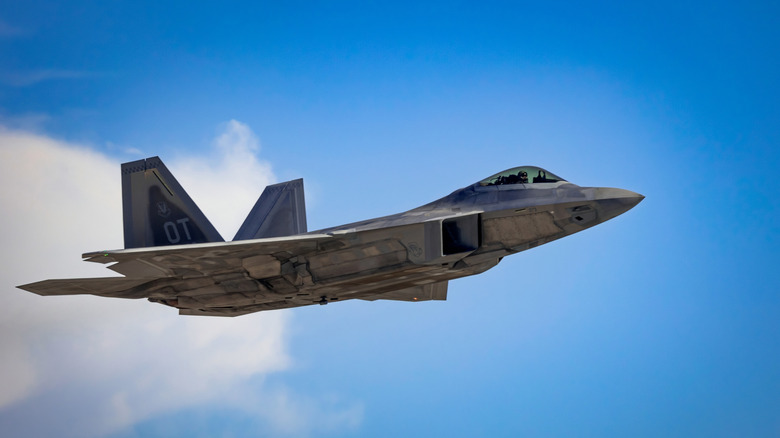
The Eurofighter Typhoon and the Lockheed Martin F-22 Raptor are two of the most advanced fighter jets in existence today. Given that both these jets have been widely used, and have had a long and illustrious operational history behind them, it is not uncommon for people to compare the two. Both aircraft feature a twin engine design and possess the capability to reach speeds of Mach 2 (the F-22’s top speed is classified). In almost all other aspects, however, the Eurofighter Typhoon and the F-22 Raptor are as different as chalk and cheese, chiefly because both fighters represent two distinct schools of military aviation.
The key differences between the two stem from their reason for existence. When the F-22 was conceptualized in the early 1980s, its goal was an air superiority fighter capable of replacing the F-15. When it eventually became operational, the F-22 did go on to become the world’s first operational fifth generation fighter. The F-22’s stealth-first design meant it did not need to carry the widest variety of weapons under its belly. The focus, instead, was to ensure that it could destroy enemy targets before they even detected its presence.
As for the Eurofighter Typhoon, it was also conceptualized as an air-superiority fighter to replace aging European jets. While it started off as a 4th generation fighter, it has received several updates over time that have led to it being classified as a 4.5 generation aircraft. The Eurofighter program was also a transnational initiative, combining the efforts of four countries: the United Kingdom, Germany, Italy, and Spain. And while it has several stealth-oriented features, it cannot approach the F-22’s level of low observability.
Stealth, speed, and weapons capability
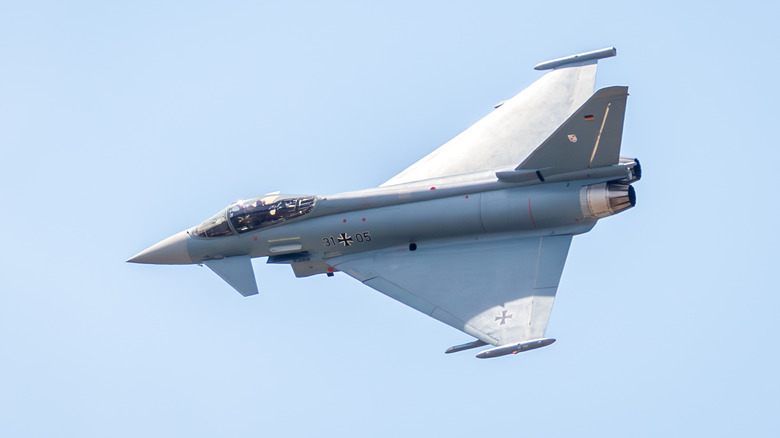
While the F-22 was built from the ground up as a stealth aircraft, it is not as though the Eurofighter Typhoon doesn’t make an effort in the same direction. Sure, it may not have the sheer stealth-focused wizardry of the F-22, but the Typhoon has several tricks up its sleeve to reduce its visibility to enemy radars. These include its carbon-fiber composite construction, and use of reinforced plastic, aluminum, lithium, and titanium casting. It also boasts a low frontal radar cross-section, features an array of passive sensors, and is among the few fighter jets that can supercruise. Where the Typhoon really makes an effort in stealth is by using a wide range of electronic countermeasures. Like the Dassault Rafale, the Eurofighter Typhoon can digitally hide its electronic signature and make it look like something else to enemy radar, making it difficult to target.
In terms of speed, both aircraft can hit speeds of up to 2.0 Mach. The F-22’s top speed is classified, and the Typhoon’s is officially listed at 2,495 kilometers per hour (1,550 mph). Both have an operational ceiling altitude exceeding 50,000 feet. The Eurofighter comes powered by twin Eurojet EJ200 turbofan engines that make 90 kN (20,000 lbs) each of thrust, while the Pratt & Whitney F119-PW-100 engines used by the F-22 Raptor generate 156 kN (35,000 lbs) each, making it much more powerful.
The F-22’s emphasis on stealth limits the amount and variety of weaponry it can carry internally compared with the Eurofighter Typhoon’s external loadout. The Typhoon has 13 hardpoints capable of carrying a wide assortment of missiles, bombs, fuel tanks, and mission equipment. By comparison, the F-22’s standard air-superiority loadout consists of eight internally carried missiles — six AIM-120 AMRAAMs and two AIM-9 Sidewinders. Although the F-22 can carry additional weapons externally, doing so compromises its low-observable profile.
The F-22 would have the advantage in a fight
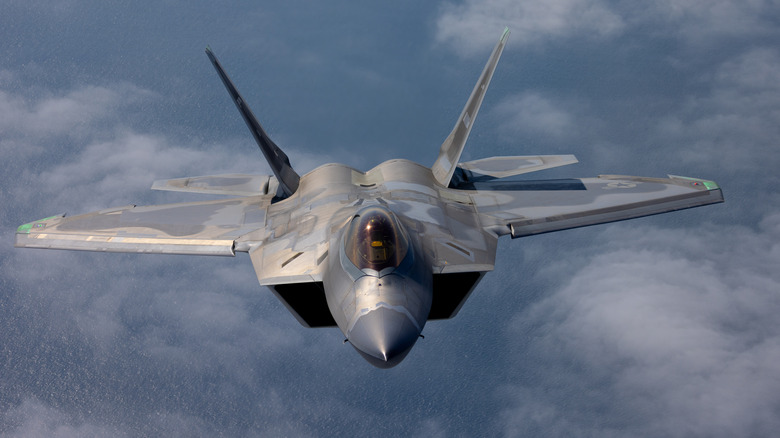
In the real world, there is very little chance of the F-22 and a Eurofighter Typhoon facing each other, given that the U.S. and the countries that operate the Typhoon are allies. In the unlikely event of that happening, it is undeniable that the F-22 would be at an advantage right from the start. To begin with, the F-22 flying stealthily would be much more difficult to detect, while the Typhoon, despite its electronic stealth technologies, may not be entirely invisible to the Raptor’s AN/APG-77 AESA radar and integrated avionics. That potentially allows an F-22 to detect and launch a missile at a Typhoon before the Typhoon can establish an equally useful track on the Raptor.
The Typhoon isn’t entirely defenseless in such a scenario. Newer variants have been upgraded with new electronic warfare systems and come armed with the MBDA Meteor, one of the world’s most advanced beyond-visual-range air-to-air missiles. If the fight progresses to visual range, the Typhoon’s exceptional maneuverability would also make it a dangerous opponent to the F-22. That being said, even after coming into close contact, the F-22 is known for its agility and remarkable maneuverability.
While the Eurofighter Typhoon can certainly challenge the F-22 in a one-on-one fight, its success depends a lot on ancillary support, ranging from AWACS, the type of electronic warfare and weapons being used, and most importantly, the conditions under which the engagement begins. In simpler words, the available capabilities strongly favor the F-22 — particularly because it was specifically designed to see and shoot at aircraft like the Typhoon before they can effectively shoot back.
