5 4-Seater Sports Cars With Better Ratings Than The Ford Mustang
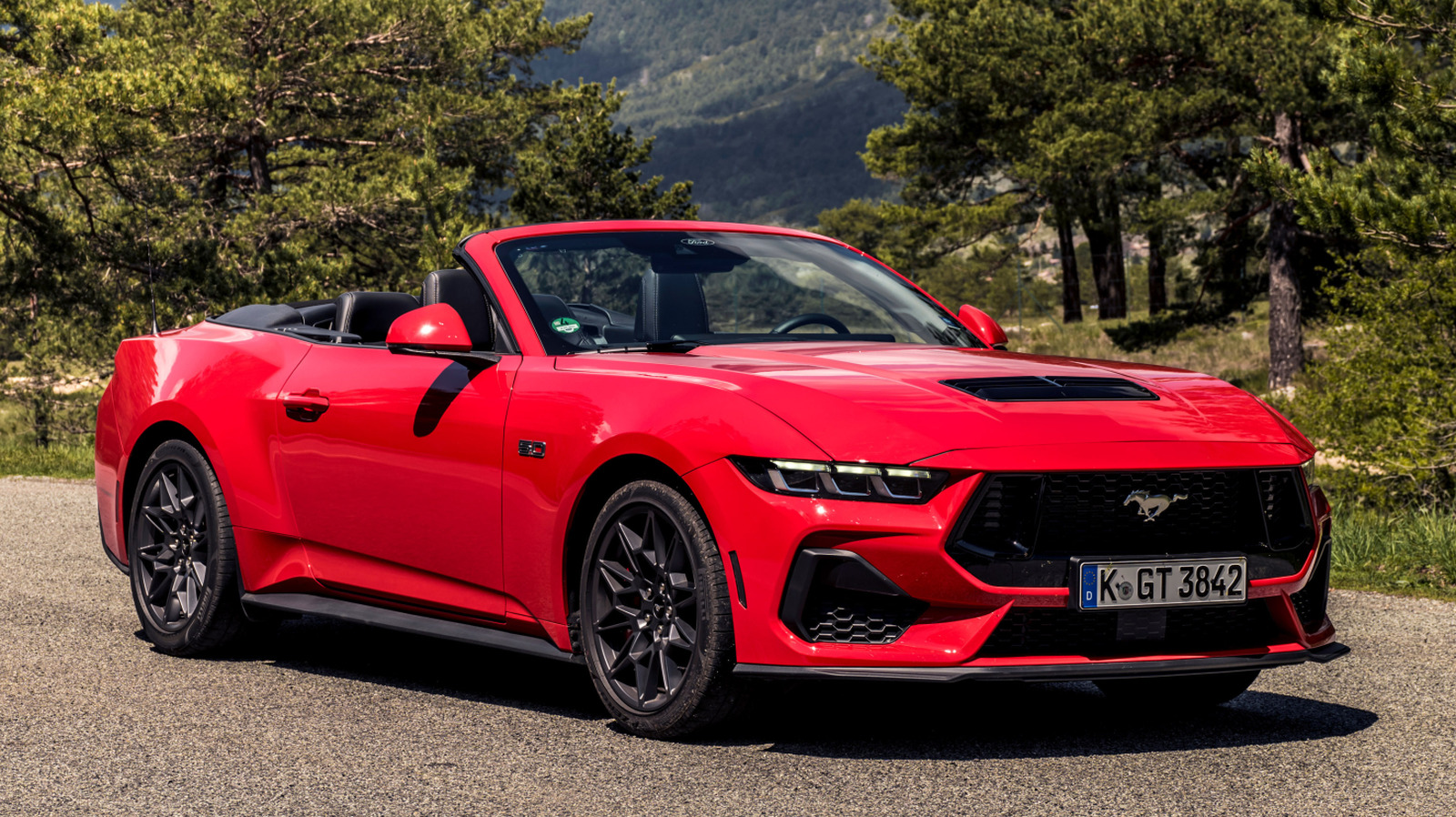
The Ford Mustang is a fine example of a four-seater sports car, but other cars of its type have received higher ratings from numerous sources. Different publications have different criteria for rating vehicles, so any given list picking the best four-seater sports cars won’t be identical to the others. With that in mind, let’s first look at the Ford Mustang, our initial standard of comparison.
The 2026 Ford Mustang comes in both coupe and convertible, and is one of the car brands keeping convertibles alive in 2026. The current version is available with several different powertrains, starting with a 2.3-liter EcoBoost producing 315 hp, mated to a 10-speed automatic transmission driving the rear wheels. A larger, 5.0-liter V8 engine with 486 hp comes with the GT model, which also gives you the option of a six-speed manual. Above that is the track-capable, 500 hp Dark Horse, which itself sits a sizeable notch below the supercharged, 5.2-liter 795 hp Dark Horse SC.
Performance testing of the Mustang GT by Car and Driver revealed a 0-60 mph run of 3.7 seconds and a quarter-mile time of 12.2 seconds at 118 mph. The Dark Horse came in slower than the GT in straight-line speed, but out-cornered it, 1.07g to 0.97g, thanks to stickier, track-focused tires.
Practical aspects of the Mustang include 13 cubic feet of trunk space. Passengers get 55 cubic feet of space in the front, but just 30 cubic feet in the back seat. Pricing starts at $34,990 including destination.
Maserati GranTurismo/GranCabriolet
The Maserati GranTurismo coupe and GranCabrio convertible appeared on three of the lists we consulted, reaching fifth place on the Car and Driver list (above the sixth-place Mustang), sixth place on the Auto Express list (above the eighth-place Mustang), and ninth place on the MotorTrend list (below the third-place Mustang). Our review of the Maserati GranTurismo praised its exceptional performance, comfort, and looks.
The Maserati GranTurismo and GranCabrio are motivated by a 3.0-liter, twin-turbo V6 engine that has an output of 483 hp in the standard model, ramping up to 542 hp in the top-of-the-line Trofeo model. An eight-speed automatic transmission sends these cars’ power to all four wheels. Performance testing of the higher-powered Trofeo version by Car and Driver produced a 0-60 mph time of 3.2 seconds, with a quarter-mile time of 11.5 seconds at 121 mph. Cornering on the skidpad came out to 0.97g.
Trunk space in the GranTurismo coupe is around 11 cubic feet, but the GranCabrio convertible cuts that to 4.6 cubic feet when the top is folded down. Unlike most of the others here, the Maserati GranTurismo has a back seat suited to short trips for those under six feet in height.
Pricing is the highest of any car on this list, with the GranTurismo starting at $150,395 including destination, and the GranCabrio beginning at $160,495. And don’t forget to leave some room for options, as Maserati offers the services of its Officine Fuoriserie, where you can specify a one-of-a-kind Maserati.
BMW M4
The high-performance version of the 4-Series, the BMW M4 comes in both coupe and convertible versions. It placed third on the Auto Express list and seventh on the MotorTrend list. We also took a closer look at this car to see how fast the BMW M4 really is.
This car gets its power from a 3.0-liter inline six-cylinder engine with twin turbos, producing one of three power outputs. You get 473 hp in the standard M4 with a choice of six-speed manual or eight-speed automatic. This increases to 503 hp in the Competition model, which comes automatic-only and can also be optioned with an all-wheel drive system that kicks it up to 523 hp.
Testing of the base M4’s performance with a six-speed manual by Car and Driver produced a 0-60 mph sprint time of 3.8 seconds, with a quarter-mile run that took just 12 seconds, reaching 121 mph. Roadholding measured out to 1.03g on the skidpad. The M4 Competition model knocked a whole second off of the standard M4’s 0-60 mph time, with a spectacular 2.8-second run.
Inside the M4’s trunk, you will find 12 cubc feet of space for your belongings. Passenger volume inside the M4’s cabin totals out at 91 cubc feet. The M4 is also more expensive than the M2, with pricing starting at $87,950 including destination and handling charges (the M2 lands at $70,850). There’s also plenty of optional equipment to choose from on the BMW order list.
Subaru BRZ/Toyota GR86
The Subaru BRZ/Toyota GR86 twins are sold under two different brands, and did very well on the various lists of four-seater sports cars. These cars placed first (BRZ) and third (GR86) with Consumer Reports, second (GR86) and third (BRZ) with Car and Driver, and fifth (GR86) and sixth (BRZ) with MotorTrend. Our comparison of these two cars asked what’s the real difference, and should you pay extra?
These sports cars are both powered by a naturally aspirated, 2.4-liter flat-four engine producing 228 hp, mated to a six-speed manual or six-speed automatic transmission driving the rear wheels. Performance testing of a six-speed manual BRZ by Car and Driver achieved a 0-60 mph time of 5.5 seconds and a quarter-mile time of 14.0 seconds at 101 mph. Skidpad roadholding was measured at 0.97g.
The amount of trunk space in these two cars is rather meager at 6 cubic feet and the tiny rear seat does not hold actual people. However, it does fold down expand the trunk space, holding four wheels and tires for your outings to a local track. Passenger space measures 48 cubic feet in the front and 30 cubic feet in the rear. Pricing begins at $32,795 including delivery for the GR86, while the Subaru BRZ starts at $37,055 including delivery. Be aware that the two brands merchandise their cars differently and also that equipment levels can vary between the vehicles, so check what’s standard before deciding on one or the other.
BMW 2-Series and M2
Both the BMW 2-Series and its hi-po sibling the M2 made all of our lists, placing first (2-Series) with MotorTrend, second with Consumer Reports (2-Series) and Auto Express (M2), and fourth (M2) with Car and Driver. Our own review of the BMW M2 found it to be too good to be thought of as merely a teaser for the M3 or M4.
Available as a two-door coupe, the 2-Series starts with the 255 hp turbo four in the 230i, moves to a 382 hp turbo six in the M240i, then goes ballistic with the 473 hp twin-turbo six in the M2, adding 50 more horses for a total of 523 in the M2 CS model. A six-speed manual or eight-speed auto can be had on the basic M2, but all other models come only with the eight-speed automatic. Rear-wheel drive is standard, but all-wheel drive is an option on all but the top-trim CS.
Testing by Car and Driver provided a variety of 0-60 mph times ranging from 5.1 seconds for the 230i down to 3.3 seconds for the M2 CS. Times in the quarter-mile went from 13.7 seconds at 101 mph for the 230i to 11.3 seconds at 128 mph for the CS. Roadholding was on a spectrum of 0.92g for the 230i up to 1.05g for the sticky-tired CS.
Trunk space amounts to 14 cubic feet in these BMWs. Passenger volume is 54 cubic feet in the front seat and 34 cubic feet in the rear, with Car and Driver calling the rear seat “fairly useless.” Pricing starts at $43,550 including destination.
Porsche 911
The Porsche 911 ranked highly on the lists of four-seater sports cars, placing first with both Car and Driver, who called it a “sports car benchmark,” and also the Auto Express list, while placing fourth on MotorTrend (below the third-place Mustang).
Its most basic Carrera form, the Porsche 911 offers a staggering array of different versions, from the basic dual-clutch automatic Carrera to the Carrera T with a manual transmission to the hybridized GTS. Further excursions into the stratosphere, in both performance and price, can be yours with the superfast Turbo and the track-ready GT3. Our recent experience with the Porsche 911 confirmed that it still deserves its reputation as one of the great sports cars of all time.
The Porsche 911 is available as a coupe, a cabriolet (convertible), or a Targa in 4S form. Rear-wheel drive is standard, with all-wheel drive an option. In Car and Driver performance testing, the basic Porsche 911 Carrera with a 3.0-liter flat-six twin-turbocharged engine with 388 hp did 0-60 mph in 3.1 seconds, with the quarter-mile taking 11.4 seconds at 121 mph. Skidpad roadholding was measured at 1.09g. Not bad for the “entry-level” version, even if it does start at $137,850 including delivery. And that’s before you add any options.
Practically speaking, the Porsche 911 gives you a total of five cubic feet of space in its front trunk, with the passengers getting 49 cubic feet of room inside the vehicle. While the 911 is technically a four-seater car, the rear seats are pretty much unsuitable for anyone of adult size and height.
Methodology
Overall ratings were determined based on a variety of lists from different sources that included Car and Driver, Consumer Reports, MotorTrend, and Auto Express from the U.K. While the specific rankings varied between the different publications, the cars included here were rated higher than the Ford Mustang on most lists, with the exception of MotorTrend, which rated the Mustang in third place. The other lists rated it much lower.
As a result of this variability from list to list, these cars are ranked in approximate order of their ratings, from the lowest to the highest, with the Mustang placed first, since it is the car on which this comparison is based.
