5 Cars That Prove 2017 Was The Best Year For Ford
The American automotive industry has changed immensely over the last decade. Not only have we seen a shift away from sedans and small cars toward trucks and SUVs, but American automakers also embarked on an ambitious (and increasingly fruitless) move toward electric vehicles, which peaked in the early 2020s.
Ford has been part of that shift; it phased out some of its most established and once-beloved global car nameplates, filling that space in its lineup with additional truck and SUV models. The company did this while embarking on a seemingly unsuccessful pivot towards EVs, one that it will spend $19.5 billion to restructure.
Ford’s current lineup includes some impressive truck and SUV models like the Bronco, F-150 Raptor, and the new Maverick, but for driving enthusiasts and performance car fans, looking back at mid-2010s Ford and the excitement around it feels like a glimpse into another era. From inexpensive hot hatchbacks to race-winning supercars, we think 2017 was Ford at its modern peak. Below are five memorable Ford models that show just how great this year was — and also how much the company has changed since then.
Mustang Shelby GT350
In 2017, the fully redesigned S550-generation Ford Mustang had been on sale for two model years with a variety of powerplant options, and the GT350 represented the top end of the lineup. Taking its name from the legendary Shelby GT350 Mustangs of the 1960s, the GT350 and GT350R took the Mustang’s platform and elevated both its performance and its mechanical excitement to new levels.
Ford had already been building high-horsepower, supercharged Shelby Mustang variants for a while, but the GT350, which debuted for the 2016 model year, went in a totally different direction. It had no supercharger, and its 5.2-liter V8 was quite small compared to the competition — but that’s exactly what made the GT350 so special.
The GT350’s naturally aspirated Voodoo V8 was unlike anything that came before it. It made 526 hp and used a flat-plane crankshaft, giving it a redline of over 8,000 rpm. It sounded as much like a Ferrari as it did your typical V8 Mustang, and, unlike newer performance variants of the Mustang, was only available with a six-speed manual. Subsequent Mustang models, including the supercharged Shelby GT500, would eclipse the GT350’s performance, but that hasn’t made the earlier, naturally aspirated models any less impressive. Today, when we look back on Ford of the mid-2010s, the Voodoo-powered GT350 stands out.
Ford Fiesta ST
One of the great things about Ford in the 2010s was that it didn’t limit its performance vehicles to its higher-priced models. Look no further than the Ford Fiesta ST, which was sold in the United States between the 2014 and 2019 model years. The Fiesta ST wasn’t the fastest ST model that Ford ever sold, but whatever it lacked in horsepower or raw lap times, it more than made up for with its fun factor.
Its small size, punchy turbocharged engine, and manual gearbox earned the Fiesta ST praise from motoring journalists and drivers alike — both in the U.S. and globally. For the 2017 model year, the Fiesta ST had an affordable base price of just over $22,000, which, adjusted for inflation, is still less than $30,000. Unfortunately for hot hatchback fans, Ford dropped the Fiesta lineup, including the ST, when it cut its small car offerings in the late 2010s.
Today, with all cars — and especially enthusiast cars — getting more and more expensive, the cheap Fiesta ST is a hero from a bygone era. Despite being one of the cheapest performance cars of its time, the Fiesta ST is among the mid-2010s Ford models most likely to become a classic. In fact, it may already be one.
Ford Focus RS
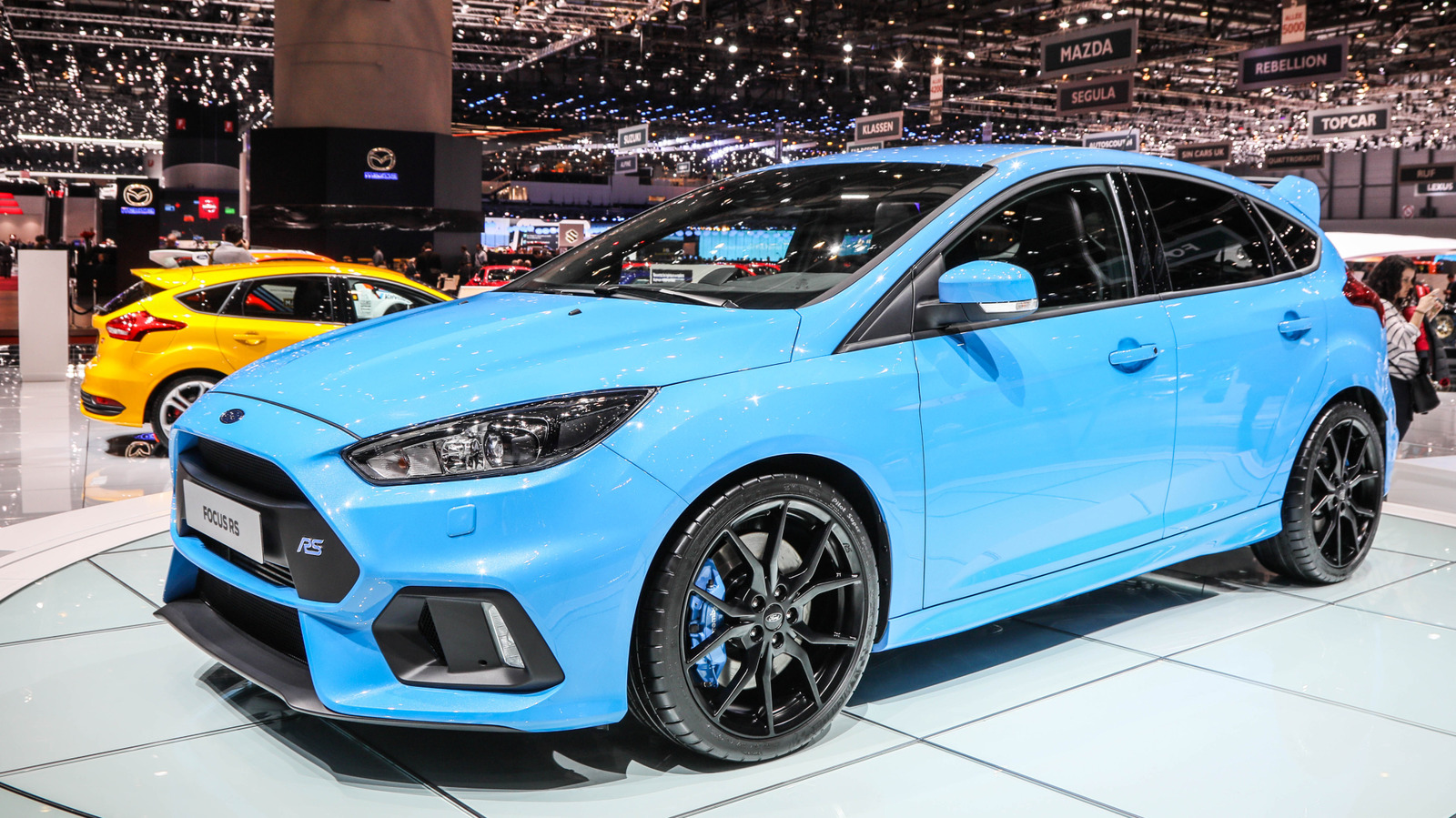
There have been many amazing hot hatchbacks over the years, but the North American market was often deprived of some of the greatest — except for one. In 2017, North American Ford dealers had not one, not two, but three different hot hatches for buyers to choose from. At the entry level was the subcompact Fiesta ST, followed by the larger and more powerful Focus ST — both front-wheel drive models. Then there was the ultra-hot Ford Focus RS, which arrived in America for the 2016 model year.
The Focus RS used a 2.3-liter turbocharged EcoBoost engine rated at 350 hp and 350 lb-ft of torque and, unlike its hot hatch siblings, sent its power to all four wheels. The Focus RS’ all-wheel-drive system was of the torque-vectoring variety, and the car even included a drift mode for tire-smoking oversteer shenanigans. The Focus RS was a fast, manic, rally-bred monster machine that was still practical enough to be a daily driver. As with the rest of Ford’s late-2010s hot hatchbacks, the Ken Block factor also helped turn the Focus RS into a generational icon.
While it’s not completely impossible that Ford would ever build a car like this again, we certainly can’t see the company building another gasoline-powered hot hatchback anytime soon. As of 2026, the closest thing you can get to a Focus RS in the Ford lineup would be the all-electric Mustang Mach-E Rally.
Ford Fusion Sport
Aside from Ford’s 2017 lineup of brilliant muscle cars and turbocharged hot hatchbacks, the company also sold one of the greatest sleeper sedans of the modern era. That car was the Ford Fusion Sport, which was introduced for the 2017 model year.
While many modern cars use the “Sport” branding lightly, the Fusion Sport introduced substantial mechanical upgrades to Ford’s popular midsize sedan. The highlights were a 325-hp twin-turbocharged 2.7-liter V6 engine, with an all-wheel-drive system to put that power down. To most eyes, it looked like any other Fusion model, but the Fusion Sport hit 60 mph in just over five seconds and ran the quarter-mile in the high 13s in Car and Driver’s hands. The Fusion Sport wasn’t just about straight-line speed, though; Ford also added adaptive dampers to improve its cornering.
While it may not have been as hard-edged or track-focused as Ford’s other performance offerings of the era, the Fusion Sport’s underappreciated status as a sleeper performance sedan is just another example of how deep Ford’s car lineup was at this time. Ford discontinued the Fusion Sport after the 2019 model year, with the rest of the Ford Fusion lineup being discontinued shortly after.
Ford GT
Having a stout lineup of affordable and exciting performance cars earned Ford a lot of praise in the mid-2010s, but the car that sat atop the brand’s lineup, the Ford GT, will not be forgotten anytime soon. Though it left behind the supercharged V8 of its mid-2000s predecessor in favor of a twin-turbocharged V6, the 2010s Ford GT was, and still is, one of the fastest and most exotic production vehicles that Ford has ever built.
The 2010s Ford GT wasn’t just a car for wealthy collectors or track-day enthusiasts, either. It had genuine motorsport chops, and the race version of the GT made history by winning the 24 Hours of Le Mans in 2016. Not surprisingly, despite being less than 10 years old, Ford GTs from this era already sell for significantly more than they cost when new, and we don’t see those prices going down anytime soon.
Ford does, in a sense, have a modern equivalent to the GT in the form of the Mustang GTD, Ford’s 2020s supercar. Despite the GTD’s exotic performance hardware, though, it still uses both the name and general bones of the higher-volume Mustang. Meanwhile, the Ford GT, which ended production in 2022, was a bespoke halo car with racing pedigree to match.
Our methodology
With a company that’s been around as long as Ford, we could have chosen any number of years to discuss here. While Ford may have had better-selling or more influential vehicles in other years, we chose 2017 for its strong and diverse lineup of enthusiast offerings that showcased the company’s engineering prowess in a wide variety of ways. Additionally, unlike many of Ford’s earlier years, the excitement of the company’s mid-2010s lineup is recent enough to be vividly remembered by today’s enthusiasts, instead of just being something to be read about in history books and retrospectives.
