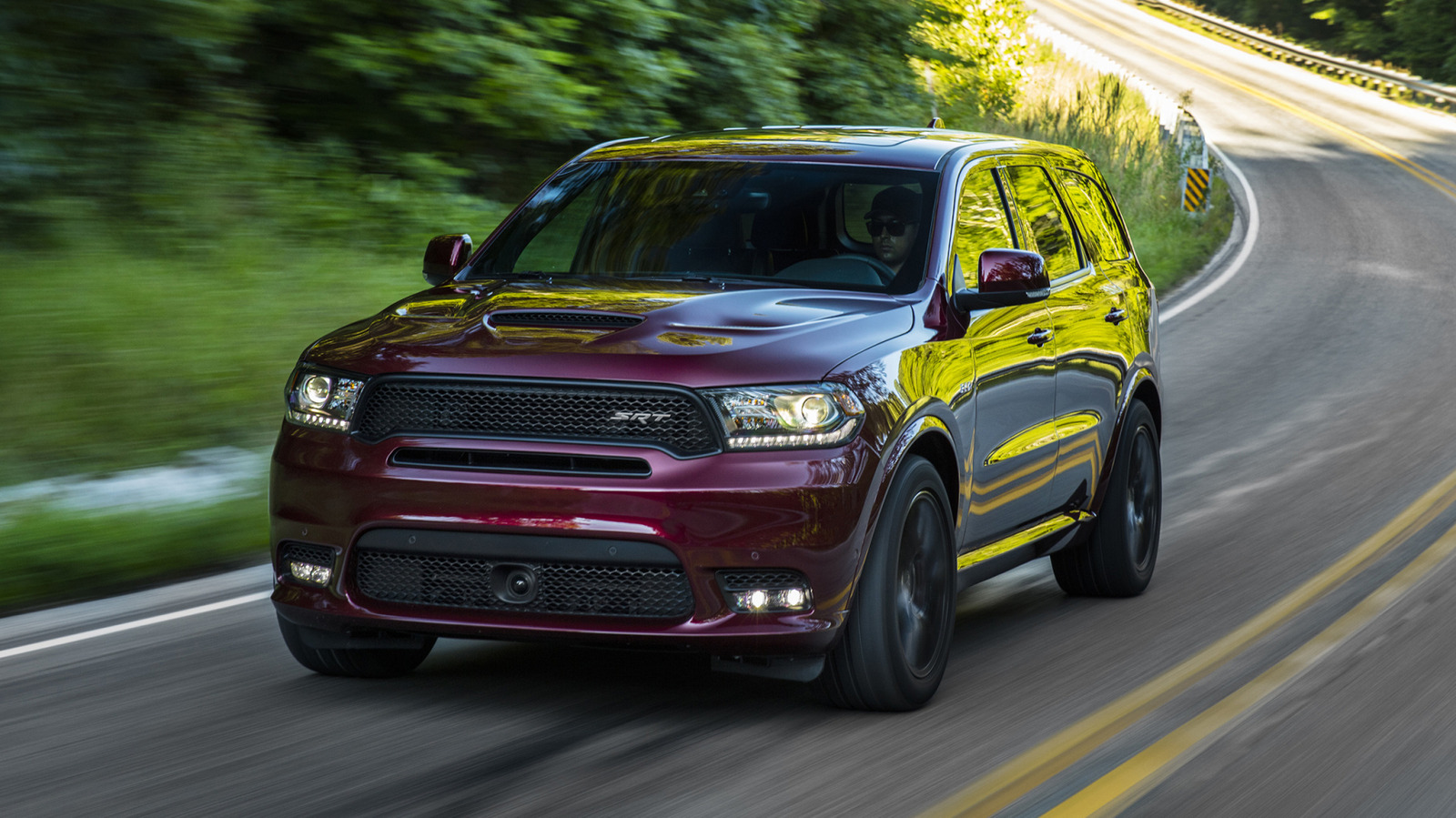
5 Pricey Repairs Dodge Durango Drivers Should Probably Be Prepared For
The Dodge Durango has survived longer than most full-size SUVs by refusing to become just another family crossover. Even in its later years, the Dodge Durango kept offering real muscle, rear-drive-based underpinnings, and higher towing capability than many of its rivals, which is exactly what made it appealing in the first place.
The third-generation Durango has been around since 2011, and even though Dodge has updated it along the way, some of the repairs most likely to get expensive are tied to older hardware, aging seals, heat-cycled engine parts, and electronics that can become painful once the warranty is gone. Some problems are mostly annoying at first, like a ticking manifold or a glitchy screen, while others can turn into four-figure repairs before the owner realizes how serious they are.
That does not make the Durango a bad used buy. In fact, many of them can be solid if you land on the right engine and model year, as the SUV’s basic formula is exactly why many owners put up with its flaws. But shoppers looking at a used V6, 5.7-liter HEMI, or SRT model should know where the repair money usually goes.
1. HEMI lifter and camshaft failure
The most expensive problem on this list belongs to HEMI-powered Durangos, especially third-generation models fitted with the 5.7-liter V8 and the higher-performance 6.4-liter V8. This is not a Durango-only defect; instead, it is a broader Gen III HEMI valvetrain problem that has shown up across several Dodge, Jeep, Chrysler, and Ram models. The failure usually starts with a sound famously known as the “HEMI tick,” but the expensive version of that noise comes from the roller lifter and camshaft wearing each other down.
The lifter is supposed to roll smoothly over the cam lobe, but once the roller stops doing its job, it can grind into the camshaft instead. As the cam lobe wears down, that cylinder can no longer breathe properly, which is when drivers describe the tick turning into a rough-running engine, cylinder misfire, flashing check-engine light, or shaking under load. In more severe cases, the lifter does not just wipe out the cam lobe; it can seize or break down inside the valvetrain, forcing the engine to keep running with damaged pushrods, valves, springs, and metal debris moving through the oil system. At that point, the repair can move past a cam-and-lifter job and roll into a complete engine failure.
Repairs start around $4,000 for a cam-and-lifter swap but can exceed $7,000 when the failure damages more of the valvetrain. FCA’s STAR bulletin documents the fix yet offers no recall or warranty extension, so free coverage ends when the factory powertrain warranty does. “HEMI tick” lawsuits are active, but none have produced a reimbursement or free-repair program for Durango owners.
2. Racetrack taillight water damage
Third-generation Dodge Durangos built from 2014 through 2023 share the full-width LED “racetrack” light bar that runs across the liftgate. The lamp is sealed with slim gaskets at each end and around the license-plate section, but those seals can weaken over time and let rainwater or car-wash spray creep inside the housing. Once moisture is trapped, it lingers against the circuit boards and LEDs instead of draining away, setting the stage for an electrical failure.
It usually starts with condensation or water collecting behind the rear light assembly, and before long, whole stretches of the Durango’s racetrack light bar dim, flicker, and finally go dark. Because the license-plate lights and rear camera are tied into the same hatch area, the problem can spread beyond the light bar, with some owners reporting that repaired assemblies fail again, corrosion, or even a burning smell from the rear lighting area. Failed rear lighting also makes the SUV harder to see from behind and can even prompt a police stop.
Unlike old-school taillights, the repairs here involve replacing the entire liftgate light assembly once water kills sections of the LED strip, with bills landing around $1,200 and, in more severe cases, pushing closer to $2,000 when the license-plate lamps, seals, or wiring work gets pulled into the job. Stellantis has issued a technical service bulletin for the affected Durangos, but since it’s not a recall, not every owner will receive a free racetrack taillight replacement or a reimbursement. A class action lawsuit on the matter is still pending, but so far it has not produced a free repair program for Durango owners.
3. Uconnect screen ghost touch
This problem shows up most clearly on later third-generation Dodge Durangos, especially 2018-2020 models with the 7-inch or 8.4-inch Uconnect 4/4C touchscreens across SXT, GT, Citadel, R/T, and even SRT trims. On these SUVs, the screen is tied into audio, navigation, phone functions, Apple CarPlay, climate shortcuts, vehicle settings, and the backup camera display, which makes any screen failure far more disruptive than a simple radio problem.
The failure starts when the touch layers inside the screen begin to separate from the underlying display, usually appearing as bubbling, peeling, or spreading spots beneath the glass. Once the digitizer starts failing, the system can begin registering inputs nobody made, known as ghost touch. That means the screen jumps through menus on its own, changes audio settings, interrupts navigation, or makes simple infotainment controls frustrating and distracting to use while driving. Sometimes the screen starts interfering with functions owners rely on regularly, from climate and defrost controls to the backup camera display, random phone calls, emergency-call prompts, or camera images appearing at the wrong time.
As with the taillight issue, Stellantis has issued only dealer-level STAR/TSB guidance for diagnosing and repairing the screen — there is no recall or warranty extension, so out-of-warranty owners still foot the bill. Repairs start in the few-hundred-dollar range if the failure is limited to the touch layer, and the screen/digitizer can be replaced. But if the radio begins rebooting, going blank, losing connectivity, or affecting camera/display functions, the fix can become a full Uconnect head unit replacement costing $1,500 to $2,000 or more.
4. 3.6 Pentastar oil filter housing leaks
The 3.6-liter Pentastar V6 is the more common Durango engine, serving as the standard engine across many third-generation trims, rather than the thirstier 5.7-liter and 6.4-liter HEMI V8s. A well-known expensive repair on the 3.6 Pentastar is the plastic oil filter housing, also called the oil filter adapter or oil cooler housing.
The oil filter housing sits in the valley of the V6 engine, under the intake manifold in one of the engine’s hottest areas. That placement helps explain why the problem is so common. Constant heat cycles can crack the plastic oil filter housing or flatten the seals over time, creating an oil or coolant leak that can start out of sight, often without a warning light. At first, the leaked oil or coolant can collect unnoticed, then slowly work its way down the engine until it shows up as a driveway stain, a wet engine block, or fluid pooling near the top of the motor. Depending on where the assembly fails, it can leak oil, coolant, or both. If the leak worsens, oil can reach hot exhaust components, sending a burning smell through the cabin vents; if it continues, it can cause engine damage.
Repairs for the oil filter housing usually involve replacing the housing itself once the seals or plastic body start leaking. RepairPal estimates the oil filter adapter replacement around $400 to $600, but real-world repairs usually end up around $900 to $1,200, or higher.
5. 5.7 HEMI broken exhaust manifold bolts
The most common exhaust-related issue on HEMI-powered Durangos is the other side of the famous HEMI tick, separate from the lifter-and-cam failure discussed earlier. It is a long-running HEMI Durango problem that affects both older models and newer third-generation SUVs. The problem centers on the exhaust manifold hardware, particularly the factory bolts securing the manifold to the cylinder head.
The manifold undergoes constant heat cycling, which can eventually stress the bolts until one or more snap, usually at the rear where the repair is hardest. Once that happens, the Durango develops a startup tick that often quiets down as the metal warms up, which is why some owners mistake it for lifeless valvetrain noise or assume it is harmless. As the leak worsens, the sound gets sharper and more persistent, and what started as a faint tick is eventually diagnosed as a leaking manifold, broken bolts, or an exhaust leak bad enough to let fumes escape into the engine bay. This is not as catastrophic as some of the other problems on this list, but if left untreated, broken studs are more likely to seize in the cylinder head, turning a simple repair into a much more expensive bolt-extraction job.
Repairs can start with a manifold gasket or bolt job in roughly the $300 to $500 range, but they often climb into the $750 to $1,400 range once the manifold itself has to be replaced or broken studs have to be extracted from the head. Stellantis has issued a TSB for newer Durango SUVs, but since it is not a recall or warranty extension, out-of-warranty owners are usually still left paying out of pocket.
How we curated this list
We searched for the most common Dodge Durango problems across multiple model years, powertrains, and generations, then narrowed the list to the issues most likely to become expensive for owners once the warranty is gone. We also paid close attention to how those problems were actually being repaired, because the parts that fail most often are not always the ones that end up costing the most.
Issues covered by recalls, special coverage, or warranty extensions were treated differently, since those repairs usually do not leave owners paying the full bill themselves. Dealer guidance like technical service bulletins, on the other hand, often matters more to out-of-warranty shoppers because those documents mainly tell technicians how to diagnose and fix a known problem, not how to make it free. Finally, we made sure the issues remained relevant in the mid-2020s by checking for recent owner complaints about older Durangos, including models from the mid-2010s.
In short, every problem here had to clear the same checklist: common enough to matter, costly enough to hurt, and current enough to still be worth worrying about.
