What Does It Mean When A Ship Is ‘Commissioned’ By The US Navy?
Building a U.S. Navy ship takes years. Before she’s considered ready for duty, she has to go through construction, sea trials, and christening. But none of those steps on their own actually make her a part of the fleet. That only happens after a particular flag breaks at the top of her mast, as part of an elaborate commissioning ceremony. The flag is called the commissioning pennant, and the moment it goes up is when the ship properly starts her career in the Navy and earns the “USS” prefix, which stands for United States Ship. Before that, she’s still being tested and prepared, and referred to by her name alone or with the PCU (Pre-Commissioning Unit) prefix.
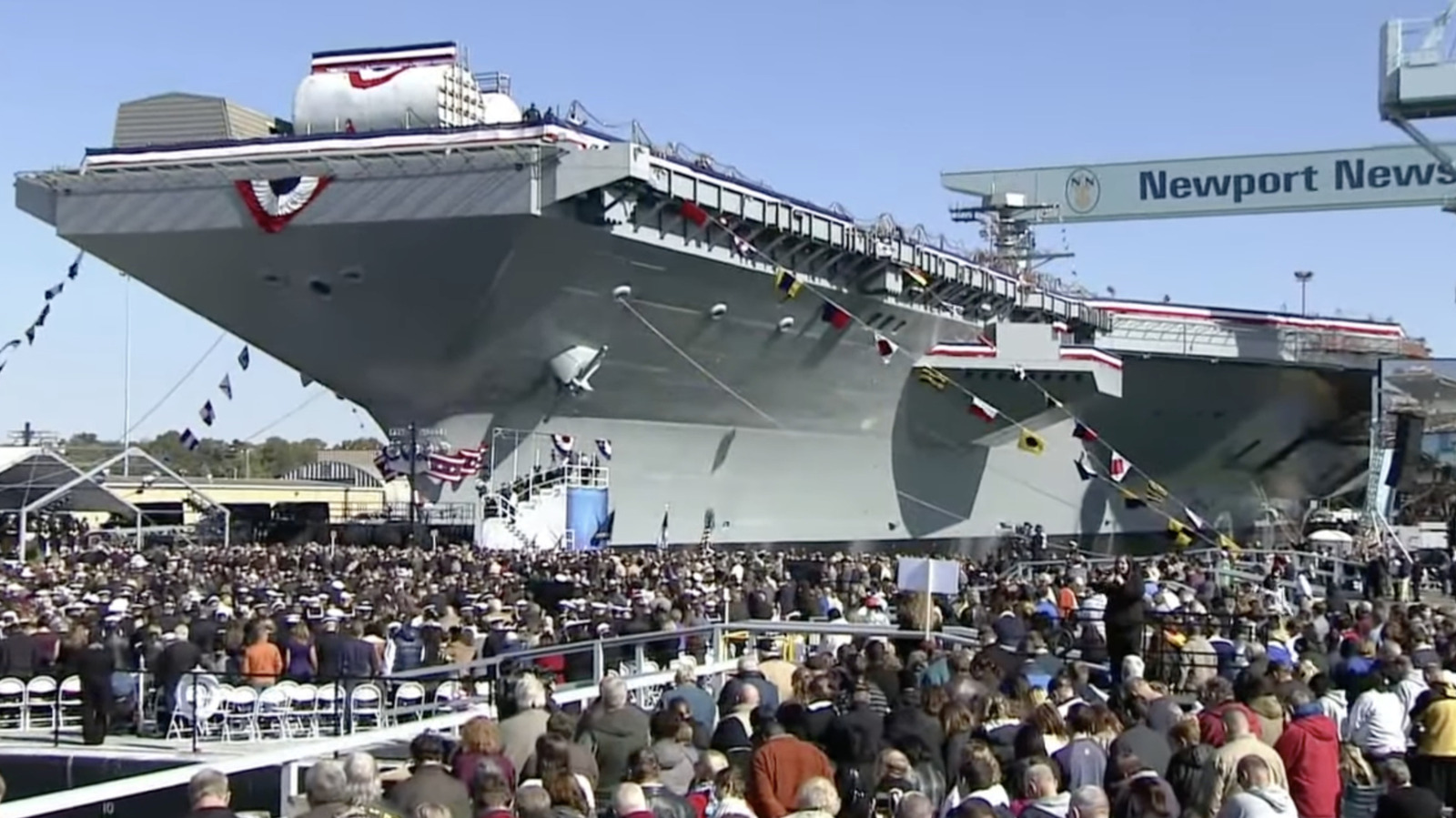
As for the ceremony itself, there’s actually a range of activities involved beyond just the pennant hoisting. Things typically kick off with flag officers and civil leaders taking turns delivering speeches. Sometimes, for notable enough ships, the head of state himself can show up, like President Donald Trump did with the commissioning of the USS Gerald R. Ford — the world’s largest aircraft carrier — at Naval Station Norfolk on July 22, 2017. During his speech, to a large audience, he called the warship a “100,000-ton message to the world”. It’s only after these speeches that the prospective commanding officer orders the colors and pennant hoisted. But then comes the iconic part.
That’s when the ship’s Sponsor (traditionally a woman) steps up and gives the order, “Man our ship and bring her to life!” On cue, the crew shouts “Aye, aye, ma’am” and breaks into a run toward the ship’s gangway, or brow. The whole ship then comes to life, with radars spinning and weapons systems swinging into position. Sailors also line the rails. All of the crew at that point gets permanently recognized as part of the ship’s original lineup. They’re known as plank owners.
A tradition as old as the country itself
This whole tradition dates back centuries, specifically to December 1775. That was when the Continental Navy commissioned its first ever ship, marking its own birth. The ship was named Alfred and the ceremony was held at Philadelphia. The tradition itself was picked up from the British. But back then, it used to be a quiet internal affair with little public attendance or press coverage. That’s actually a big reason why historians find it hard to pin down exactly when a lot of the earliest ships were commissioned. Because the ceremonies were so discreet, most of the record came down to the deck logs, which just didn’t survive all these centuries.
The first time the Navy established a written regulatory procedure is actually from November 6, 1863 — in a letter from then-Secretary of the Navy Gideon Welles – which told commandants to start officially reporting these dates.
And if you are looking for a recent example of all of this playing, just look at the USS Harvey C. Barnum Jr., which was commissioned recently, in April 2026, at Naval Station Norfolk. This ship is an Arleigh Burke-class Aegis guided-missile destroyer named after a Medal of Honor recipient who served in Vietnam.
The commissioning pennant’s backstory involves a broom and a whip
As for the commissioning pennant, it has its own backstory. As the legend goes, Dutch Admiral Maarten Tromp sailed out in the 1650s with a broom lashed to his masthead. The gesture was meant to signal he’d sweep the English right off the waves. His British rival, Admiral Robert Blake, responded by hoisting a coachwhip of his own. A coachwhip is the long, thin, tapering lash that drivers used on horse-drawn coaches, and the implication was that Blake planned on whipping the Dutch fleet instead.
He won the war, and the long, trailing profile of the coachwhip is what that gives the Navy’s pennant its unique appearance. It’s also why it’s referred to as a “coachwhip pennant” even today. That said, historians at the Naval History and Heritage Command have admitted nobody’s actually been able to verify this happened. But that hasn’t stopped the Navy from reprinting it in pretty much every commissioning program booklet handed out to attendees.
Just like there’s a ceremony at the start of a ship’s life, there’s one at the end, too. That one’s called decommissioning, and its vibe is a lot more poignant. The pennant comes down, the crew gets reassigned, and weapons and supplies get stripped from the ship. And sometimes, if it’s an aircraft carrier, or simply notable enough, the ship even ends up turned into a museum.