Who Owns Daikin And Where Are The Air Conditioners Made?
Daikin may not be the first name that comes to mind when the average American thinks about air conditioners. This is natural, given that U.S. consumers are generally more familiar with brands such as Carrier, Trane, Lennox, LG, and Rheem. What many Americans do not realize, however, is that Daikin is one of the world’s largest air-conditioning manufacturers. In fact, it owns the American HVAC brands Goodman and Amana.
Originally founded in Japan well over 100 years ago by Akira Yamada, a young Japanese engineer, Daikin initially went by the name Osaka Kinzoku Kogyosho Ltd, and was originally involved in the manufacture of aircraft radiator tubes. The company ventured into the cooling and refrigeration space in the early 30s, following which it underwent gradual expansion. Osaka Kinzoku Kogyosho Ltd opened its first ever manufacturing plant in 1937, and over the next few decades, expanded into several countries across Asia and Europe. The company changed its name to Daikin Kogyo Co., Ltd., in 1963, which was further shortened to Daikin Industries, Ltd. in 1982. Today, Daikin is a publicly listed company, and is not owned by a single private individual or family.
Although Daikin officially reached the U.S. shores in 1991, the company’s focus were primarily fluorochemical and fluoropolymer manufacturing and sales companies, not Daikin’s air-conditioning business. It wouldn’t be until 2006 that Daikin would finally begin selling its air conditioners in the country. Daikin would eventually expand its HVAC business in the U.S. and acquire brands such as Goodman and Amana, while also building expansive AC manufacturing facilities in the U.S.
Daikin’s manufacturing facilities in the U.S.
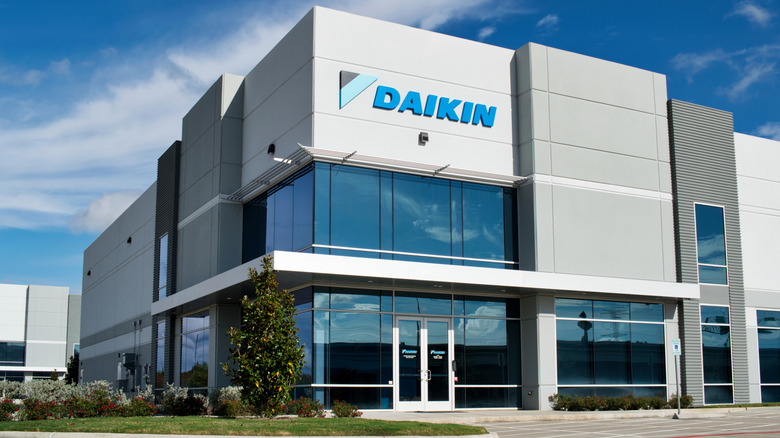
Daikin’s major push towards entering the air conditioning and HVAC space came in the mid-2000s after its AC focused subsidiary Daikin AC (Americas) was established in 2005. In 2006, Daikin acquired O.Y.L. Industries and McQuay, which gave Daikin an immediate domestic manufacturing presence in the commercial HVAC space as well as access to commercial-HVAC factories owned by these companies. However, Daikin-branded residential and ductless AC systems sold in the U.S. continued to be imported primarily from the company’s factories in Japan and Thailand. This wouldn’t change until the company acquired Goodman in 2012, along with its manufacturing assets, as well as the rights to use the Amana brand.
Daikin’s major manufacturing push for residential and ductless ACs in the U.S. market came in 2015 after it started work on its massive “Daikin Texas Technology Park”. The $450 million structure was completed in 2017, spans over 4 million square feet, and currently serves as the major hub for the production of the majority of Daikin, Amana, and Goodman products in the U.S. After the technology park was established, Goodman’s older manufacturing facilities in Fayetteville, Tennessee were shut down.
As of 2026, Daikin is a major force to reckon with in the U.S. It employs more than 25,000 people in the country, and operates as many as 24 manufacturing sites across the U.S. across various other verticals. However, its residential and ductless air conditioners are manufactured at its massive Texas facility.
Daikin’s global manufacturing footprint
Well before Daikin entered the U.S. market, it was an established player in various countries across the globe. Given that Daikin is a Japanese company, it’s hardly surprising that the first few factories were located there. Daikin’s plant at Shiga produced residential room air conditioners, while the Sakai operations focused heavily on commercial systems and compressors. Daikin reached Europe as early as 1973 when it established a manufacturing facility at Ostend, Belgium which primarily catered to Daikin’s European customers. In 1990, Daikin established a manufacturing facility in Thailand, which became a major export oriented hub, followed by an expansion into China in 1995.
In 2003, Daikin expanded its presence in Europe by adding a new facility in the Czech Republic. The mid-2000s saw additional facilities come up in various cities across China including Shanghai, Suzhou, Shenzhen, Wuhan, and other locations. These facilities were established to produce commercial systems and residential systems, as well as chillers. In 2006, Malaysia was added to the list of Daikin’s production hubs, after it gained access to a facility there following the acquisition of McQuay that year.
In 2009, Daikin opened a manufacturing facility in India, which focused on residential air conditioners. Additional production facilities were added later, with the newest one located in Sri City opening as recently as 2022. Daikin also has a significant presence in Mexico, where it started its journey in 2011. In addition to these countries, Daikin has AC manufacturing facilities spread across several other nations, including Turkey and Brazil.
