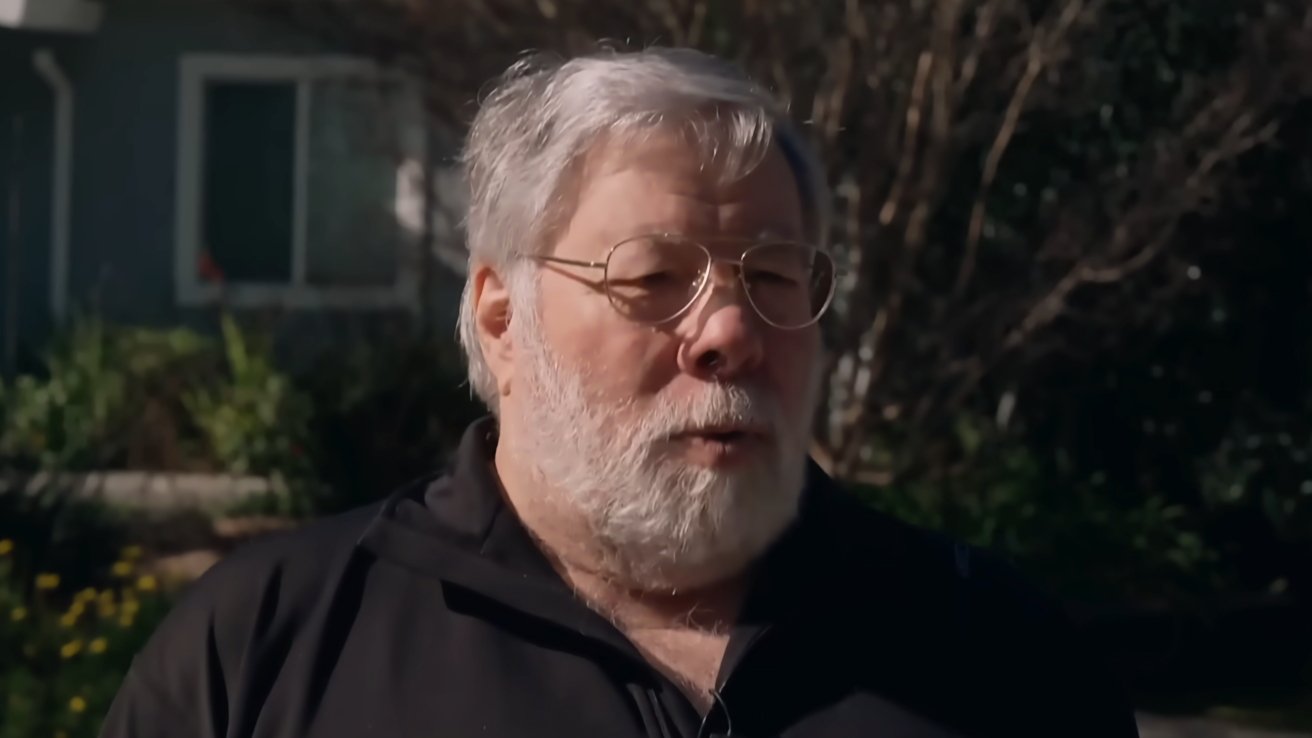
How Steve Wozniak was the soul of Apple, and is still on the payroll
It’s been over four decades since Steve Wozniak left Apple, but as co-founder and creator of the firm’s first computers, Woz still fully enjoys his place in history.
You’re an AppleInsider reader so you know Apple and inescapably, you know the story. Steve Wozniak was the brilliant engineer, Steve Jobs was the brilliant businessman, and Ronald Wayne was, er, something else.
These are the three who founded Apple in 1976, but the story of both Woz and Jobs goes back further, and really also goes deeper. Woz truly was a remarkable engineer but if he had been able to have his way, he’d have been happy giving away everything he made.
Woz is a true engineer and in “iWoz,” his 2007 autobiography co-written with Gina Smith, he wrote about how much that role means to him.
“To this day, I still believe engineers are among the key people in this world,” he wrote, “and I believe that I will be one forever, and I have dedicated my whole life to engineering.”
Clearly that ethos led to Apple, and maybe less clearly that ethos continues to pervade the company today.
What may be more surprising is that more than 40 years after he left Apple, Woz says he’s still on the payroll. Reportedly he’s getting $50 a week, meaning over the four decades he’s earned $104,000 from the company.
How he started
Stephan Gary Wozniak was born on August 11, 1950, and “Stephan” is not a typo. Woz’s mother, Margaret Louise Wozniak told him that his birth certificate was wrong, and so he says he calls himself Stephen.
His parents nurture his natural curiosity, helped by how his father had such a secret job in electronics that he never told Woz what it was. But a love of engineering and technology was instilled in Woz, and he earned his amateur radio license at 11 years of age.
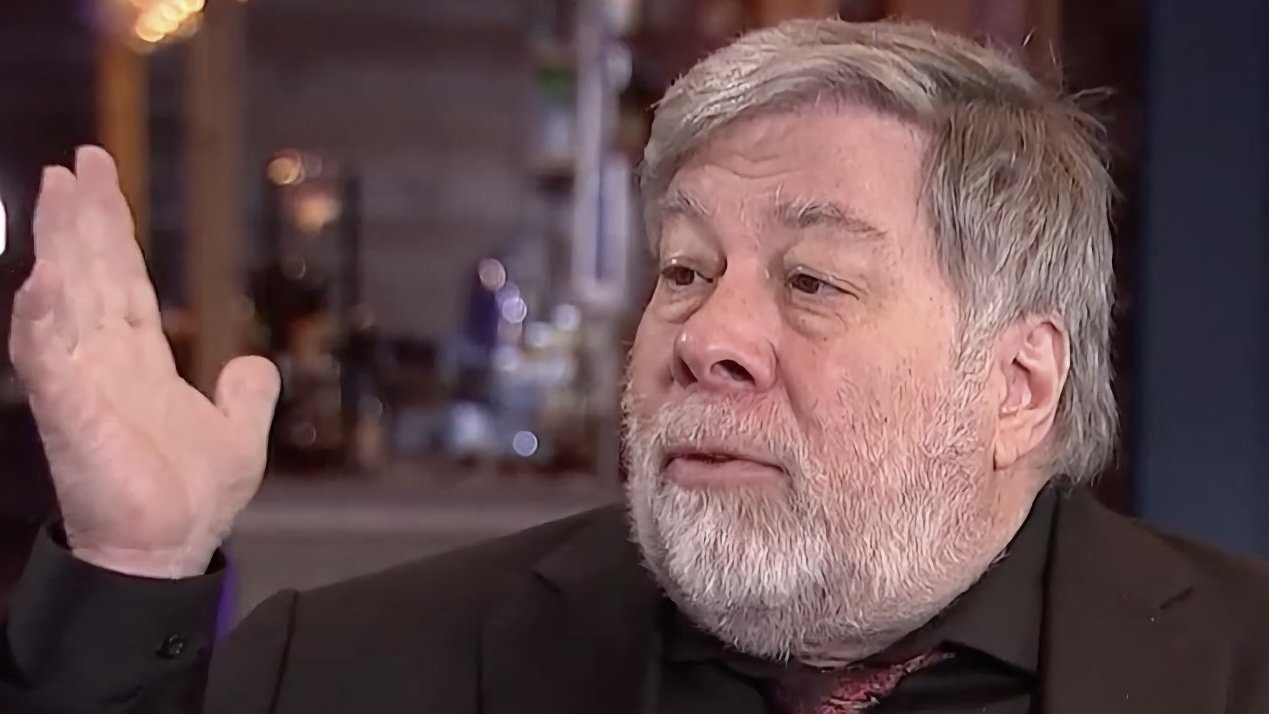
Steve Wozniak
In 1968, Woz enrolled at the University of Colorado to study computing. In 1969, he got kicked out for hacking into the faculty’s mainframe.
It was typical Woz hacking, an innocent desire to know more about how something worked, and presumably no idea that he could’ve just asked someone.
That practically childlike attitude about discovery and knowledge defines Woz. That practically meant that he would be susceptible to people like Steve Jobs who could and did talk him into money-making ventures.
Notably, the infamous Blue Box that Woz designed and Jobs sold around campus when they were both at UC Berkley in the early 1970s.
This was the box that would produce a tone of a precise frequency that happened to be what Bell used in it telephone network. Buy the box, play the tone, and you immediately had free national and international calls.
“I remember one very, very late night in the dorm when I decided to call the pope. Why the pope? I don’t know. Why not?” said Woz in his autobiography. “So I started by using the Blue Box to call Italy Inward (country code 121), then I asked for Rome Inward, and then I got to the Vatican and in this heavy accent I announced I was Henry Kissinger calling on behalf of President Nixon.”
The prank didn’t go very far. The Vatican phoned the real Kissinger to verify.
This was a student beating the worldwide phone company. That was a recurring issue with him, of being the individual who could out-think corporations.
It was only a few steps more that took Woz into being the founder of a corporation. And it only took Steve Jobs and later Apple CEO Mike Markkula to overcome Woz’s reluctance to sell technology, and later his fear of giving up his job at Hewlett Packard.
Apple I computer
Woz’s engineering skill really was ahead of his time, and especially in how he was able to create devices using a tenth as many processor chips as existing firms. Prompted by Atari offering a bonus for every chip eliminated in a new version of its Pong game, Steve Jobs challenged Woz to do it.
Jobs also said that there was a deadline four days away, and it’s not clear if that was true. But it is clear that Woz did it.
In four days, with no sleep, Woz designed and together with Jobs built legendary arcade title Breakout. It was the paddle-and-bricks game that would become famous, and Woz did it in 45 chips where some Atari games of the time were using 200 chips.
The bonus that Atari had offered was $100 per eliminated chip, so in theory Woz earned $5,000 right then in the early 1970s. Allegedly Jobs told Woz that Atari had paid only $700, and they split that amount 50/50.
Helped by how Woz reportedly didn’t find this out for years, the pair continued to be friends, and through Woz, they both went to the then-new Homebrew Computer Club. Woz saw his tribe, while Jobs saw customers.
Purely to impress his new friends at the club, Woz designed what would later become known as the Apple I. For its time, it was an impressive computer, and Woz probably looked forward to seeing it used by his friends.
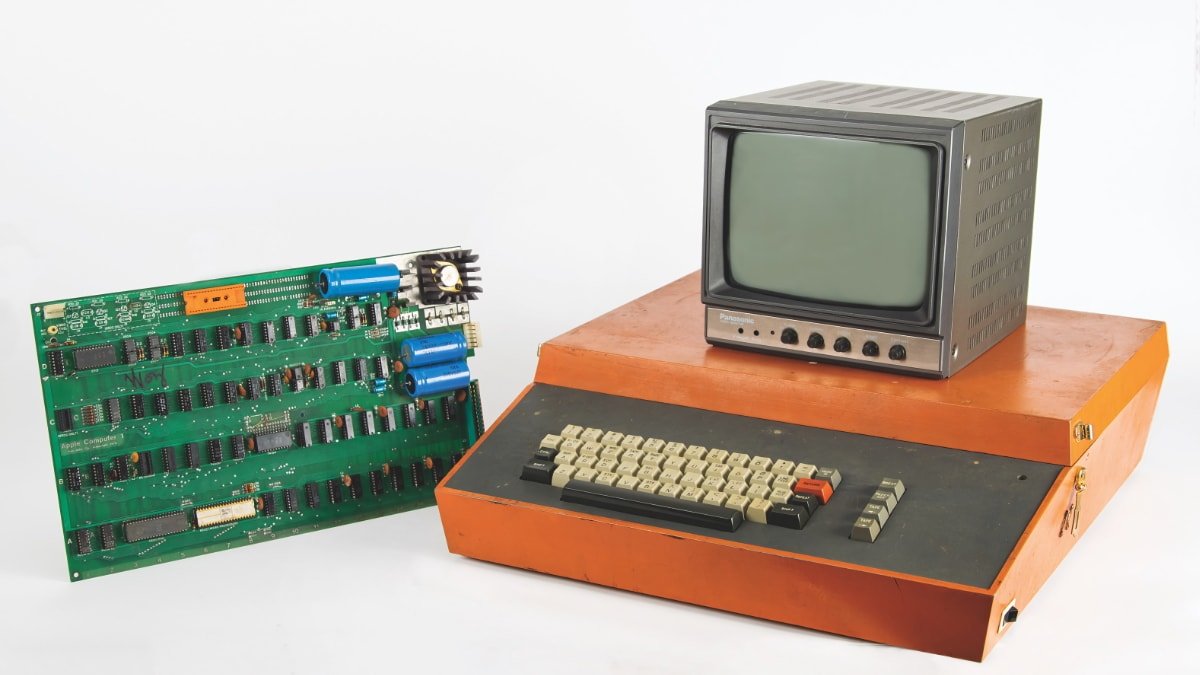
Apple-1 signed by ‘Woz’
But Jobs saw opportunity and it was because of him that Woz agreed to sell Apple I computers. This is one of the most well-known parts of the Apple story, as Jobs made a deal to assemble Apple I computers for sale at the Byte Shop.
If it weren’t for that sale, Apple would probably never have got anywhere. Even with the sale, though, there was an issue that Woz doesn’t seem to have been able to resolve by himself.
On the one hand, at this point he was working for Hewlett Packard so under the terms of his contract, all of his work belonged to them. After Apple was formed as a company on April 1, 1976, Woz needed to leave HP and he needed to bring his Apple I with him, but he resisted.
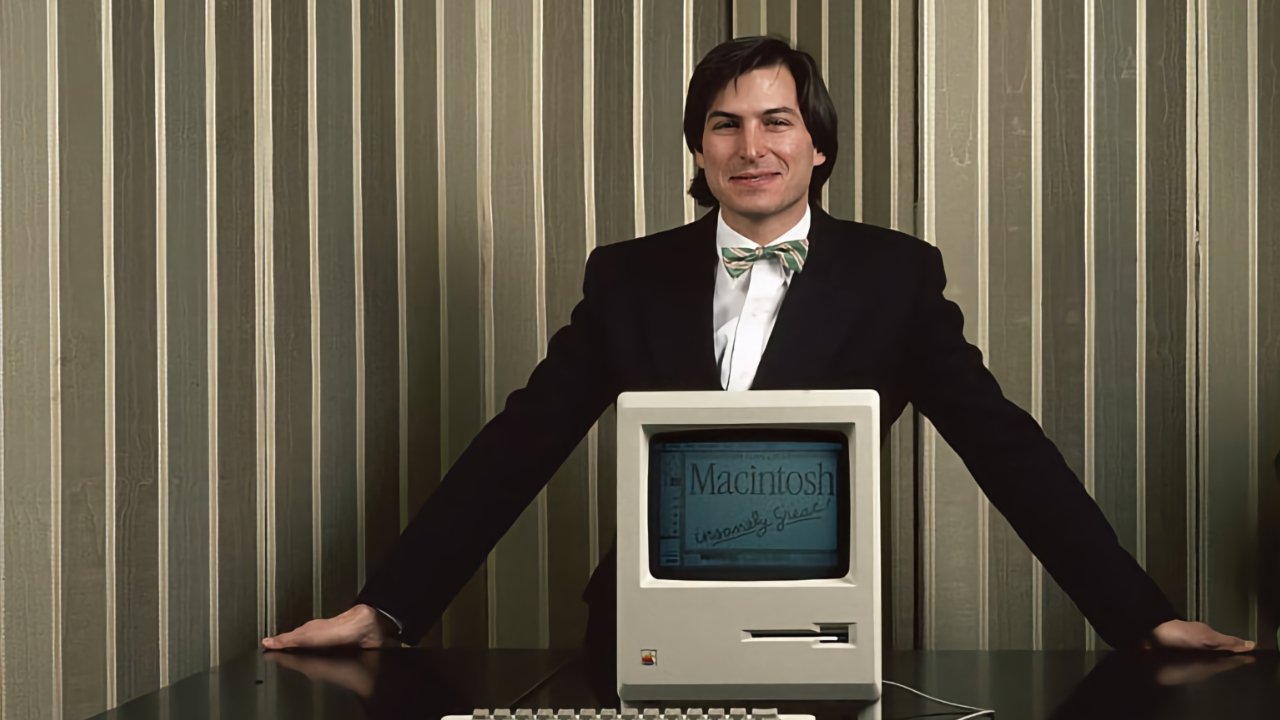
Steve Jobs knew how to market Woz’s technology skills
Fortunately for the future of Apple, Hewlett Packard wasn’t interested in the Apple I. Woz tried selling them on the idea five times and was rejected repeatedly.
Then Mike Markkula took charge of Apple and incorporated it. He demanded that Woz quit Hewlett Packard, and so he did.
Apple II is the real start and the real end
While the Apple I got everything rolling, it was really Woz’s Apple II designs that made the company. It was so successful that it kept Apple in the black even during the disastrous run of the Lisa and the early Macintosh.
The importance of Woz’s work on the Apple II is harder to appreciate now, but at the time what he did was extraordinary. In half as many chips as the Apple I — Woz really was obsessed with cutting processors — he made a color computer that was significantly faster than its predecessor.
“The Apple I made history by being the first personal computer that could work with a keyboard and a display, wrote Woz in his biography. “But the Apple II brought color, high-resolution graphics, sound, and the ability to attach game paddles. It was the first to boot up ready to use, with BASIC already built into the ROM.”
Then when it was done, Woz kept innovating. Partly because he wanted to go to the Consumer Electronics Show (CES) in Vegas, and partly because Mike Markkula wanted a floppy drive, Woz spent two weeks getting one ready.
He had never seen a floppy drive, he says, but Steve Jobs got him a then-new Shugart 5-inch drive and a technical manual that included schematics of its circuitry.
“I decided that of the twenty-two or so chips, about twenty of them weren’t needed,” he wrote.
Woz calls it a real challenge and says he worked “all day, all night, through Christmas and New Year’s” to get it done.
As a lesson in how you shouldn’t work when you’re tired, when Woz got to that CES, he accidentally erased his own program. But then in a lesson in what you can do when motivated, he rewrote the code in his hotel room.
While Woz doesn’t call it this in his biography, that floppy disk controller he designed and coded for became known as the Integrated Woz Machine (IWM). Apple’s Wendell Sander would later develop it into the Sander-Wozniak Integrated Machine, and it drove the floppy drives of Macs up to 1998.
So again Woz was working marvels, doing so very quickly, and of course reducing the chip count to make things more visually appealing. And also cheaper.
The difference with the Apple II is that this time, Woz stood up to Jobs in a design argument. Jobs was doing his thing of wanting a minimalist design and while he didn’t entirely ban expansion, he wanted it limited.
Woz insisted on having multiple slots for third-party cards to be fitted to the Apple II, and he won the day. In 1977, the Apple II launched, and shortly afterwards the world’s first-ever spreadsheet, VisiCalc, came out for it.
So at that point, Apple had arguably the best designed personal computer, it had a very good salesman in Steve Jobs, and it had an app that would transform the entire business world.
Apple was a corporation of the sort Woz used to mildly rail against, and like everyone else, Woz was getting rich. Or rather, he was getting rich like Steve Jobs and a select few others at Apple.
Woz objected to this, he believed the rewards should be spread equally. So he did something about it. He gave away a huge proportion of his own stock in the company.
Only, for all his brilliance in engineering, Woz just never paid that much attention to business. So he failed to realize the real problems his giving away shares would create for the company.
Specifically, he gave away shares to so many people that Apple was coming close to having 500 shareholders. “There are some magic numbers in a company’s history,” then CEO Mike Scott told author Owen Linzmayer in 2004, “and one of them is 500 shareholders.”
“Once you have that many shareholders,” he continued, “you must file all sorts of paperwork with the SEC [Securities and Exchange Commission].”
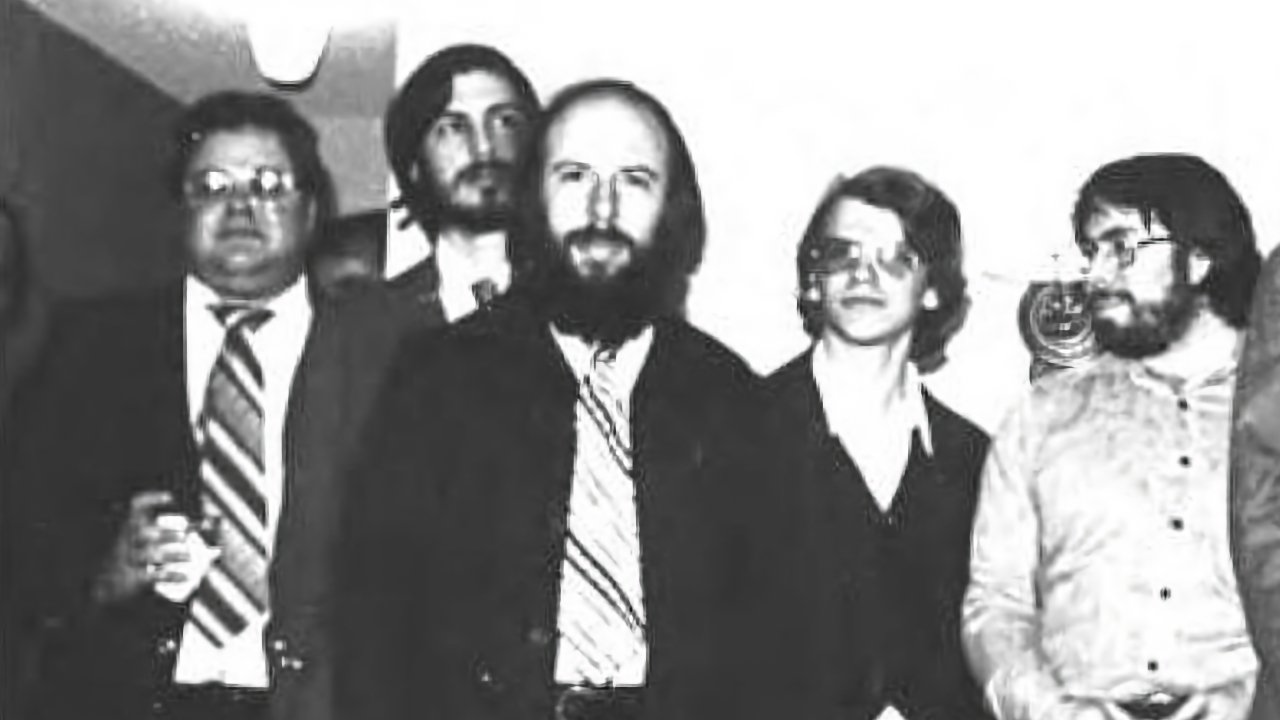
L-R: Michael Scott , Steve Jobs, Jef Raskin, Chris Espinosa and Woz in 1978 — image credit: AllAboutSteveJobs.com
What Woz did was right morally, and Jobs limiting the shares was wrong morally. But the effect was that Woz pushed Apple into going public sooner than had been planned, and maybe sooner than it was really ready for.
Given that going public made 300 Apple people millionaires, according to Jobs’s biographer Walter Isaacson. Given that, Woz was probably forgiven.
But he was then also closer to quitting Apple than anyone, Woz included, could have realized.
Apple III
Apple went public in 1980 and in November that year, it shipped the Apple III. Technically, it didn’t go great from the start.
This is the device where its processors were not sufficiently well soldered to the motherboard. Apple’s official support advice was to pick it up off and drop it in precisely the right way to get the chips to go into their slots.
For once, it was to Apple’s advantage that it was still a fairly small company. There were thousands of the Apple III rather than millions, and press coverage was far less intense than it would be today.
The Apple III had many problems, but at least one of them was back to this issue of Woz’s engineering skill clashing with Jobs’s minimalism. This time, Woz lost, and the Apple III did not ship with the fans he knew it needed, but Jobs disliked.
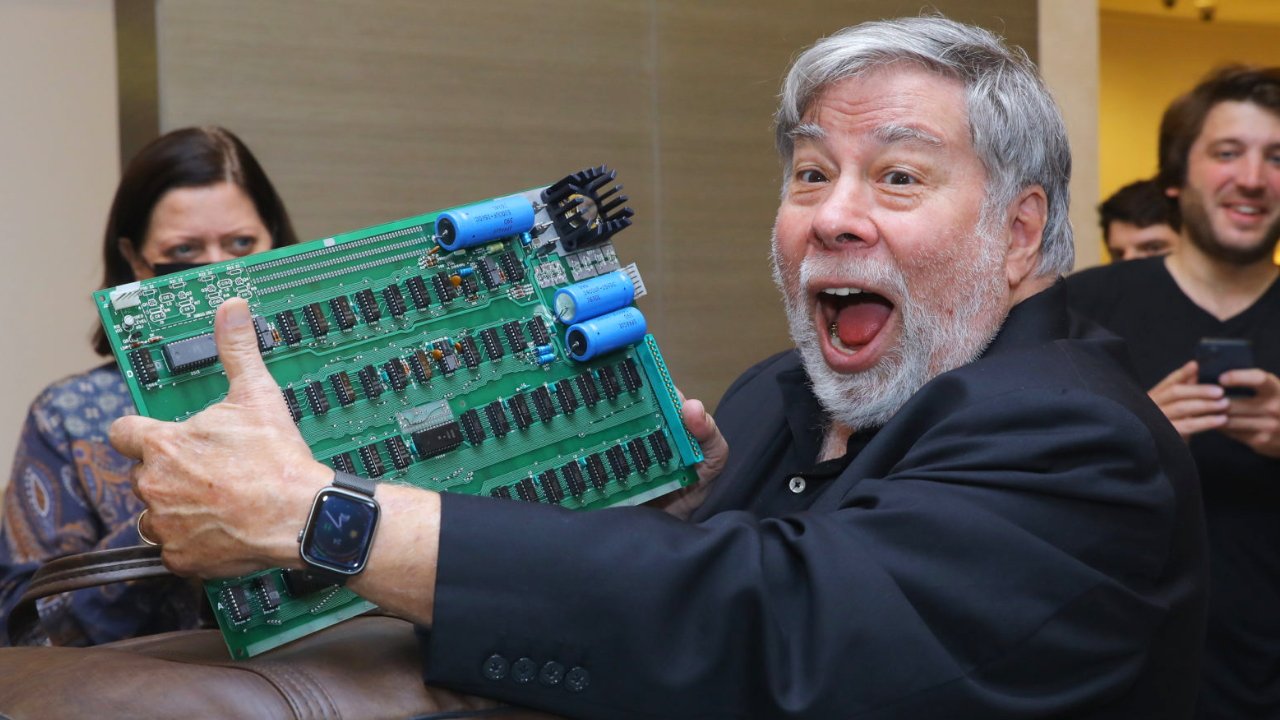 Woz with an Apple I motherboard in 2022
It shouldn’t have been manufactured so poorly, and those production problems were eventually resolved. But it took around a year, and by then the Apple III could not shake its bad reputation.
The situation for Apple was so dire at this point that Mike Scott fired a great proportion of staff in February 1981.
He could have done that a lot better, but what Scott couldn’t have imagined was that he’d lose Steve Wozniak — or quite how Woz would depart the company.
Woz’s plane crash
Also in February, 1981, Woz took his brilliant understanding of technology, and mis-applied it. Without being qualified, he tried to fly a Beechcradt Bonzanza A36TC out of what was then Sky Park Airport in Scotts Valley, California, and crashed it.
The official record says the accident was a stall during a premature lift-off, and specifies under cause of the incident, “unqualified person operated aircraft.” Woz seems to dispute that, saying in his autobiography that he’d got his pilot’s license six months before.
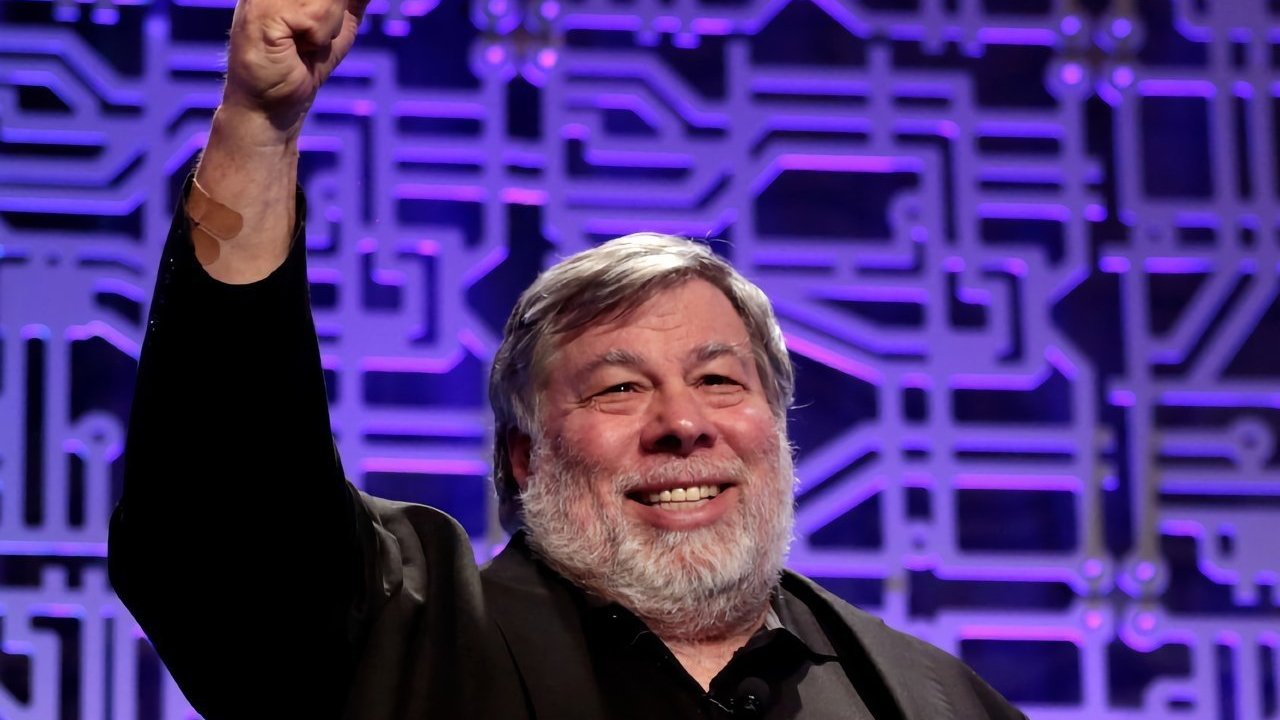
Steve Wozniak
Whatever happened, alongside Woz, there was his then girlfriend and later wife Candice Clark, whom Woz called Candi. There was also her brother Jack and his girlfriend Janet Valleau, who Woz refers to as Claris.
All were injured, and Woz’s condition was severe enough that he suffered a loss of memory.
“I remember reaching for the throttle at the start of the runway, and that’s it,” he said.
It’s probably a good thing that Candice Clark and he divorced in 1987, because he would ultimately passive-aggressively blame her for the crash.
“Later, I figured out that maybe Candi, who was sitting in the front, accidentally leaned on one of the controls,” Woz said in his book. “We’ll never know exactly what caused the accident.”
After recovering, Woz returned to Berkley to continue the degree he had started there, although he did so now under the name Rocky Raccoon Clark. He wanted to be innocuous and escape the attention that Steve Wozniak would have seen.
It’s not known whether anyone saw through this brilliant disguise. But then at this stage, his silly name was not going to be picked up by Bloomberg.
Returning to Apple and leaving again
Woz returned to Apple in 1983, under his own name, but left again in 1985. Reportedly it was because despite his Apple II keeping the company afloat, it and the team supporting it were treated as poor relations to the new Macintosh team.
Certainly by this time, Woz had earned enough money from Apple that he could support his idealism. Never one to pay attention to finances, always one to believe in sharing everything freely, he was now able to indulge himself.
And he did. In 1982 and 1983, so while he was still officially with Apple, Woz ran what he called the “US Festivals”. That was “US” as in “us,”, not United States, and it was intended to unite people in technology, music and more.
Woz lost millions on the first US Festival, and then later stated that unless the second one was profitable, he was through with the idea.
It turns out, he was through with the idea.
Post Apple
Following Apple, Woz took what he knew about running businesses and formed CL 9, a company that developer a universal television remote control. It launched such a device, based on the same 6502 processor Woz had used in the Apple II.
By 1988, the company had folded. It won’t have helped that Woz was planning to use Frog Design for the remote’s casing and Steve Jobs saw a prototype there.
“From what I heard, he threw it against a wall and put it in a box and said, ‘Send it to him,'” wrote Woz in his book.
As he tells it, though, the remote control worked, it was “amazing,” and it would perhaps still be around today. “[Only,] I ended up selling the company to someone, but they couldn’t raise money and closed it down.”
By then, though, Woz had children, and he was also teaching computer classes.
“It was at about this time that I redirected my philanthropic activities from museums and ballet to schools in Los Gatos,” he wrote. “This was about 1989, and computers in schools were starting to become the big talked-about thing. There were going to be computer ‘haves’ and computer ‘have-nots.'”
“So I started providing computers to schools — setting up computer labs with dozens of computers in them as gifts to the schools and the kids,” he continued.
Woz did that throughout the 1990s, but in 2001 he was back in business. He founded the Wheels of Zeus company (the initials are surely a coincidence) which was made wireless GPS technology for what sounds very much like the AirTags of today.
The WOZ company’s technology was licensed to Motorola in 2004, but it wasn’t enough to keep the doors open. The firm closed in 2006.
But then by that point, Woz was on the boards of Ripcord Networks and Danger, Inc, which made a smartphone. In August 2005, Woz joined with ex-Apple people Gil Amelio and Ellen Hancock to form Acquicor Management.
Acquicor initially made nothing and sold nothing, but it was intended to make acquisitions in the technology field. In 2006, Acquicor acquired Jazz Semiconductor Systems and changed its name to Jazz.
But by 2007 Hancock had left, and by 2008, Amelio quit as Jazz was sold to Tower Semiconductor in a stock for stock merger. It’s not clear when Woz left Acquicor, but he doesn’t mention the company in either his 2007 biography or on his current website.
Around then, Woz appears to have stopped founding businesses and instead joined Fusion-Io as chief scientist in 2009. That was the same year that Woz appeared on “Dancing with the Stars,” alongside professional dancer Karina Smirnoff.

Steve Wozniak and professional dancer Karina Smirnoff in “Dancing with the Stars,” 2009 – image credit: ABC/BBC Studios
Despite typically scoring low marks, if not actually the lowest, in one episode Woz beat Belinda Carlisle in the show’s dance-off. He then publicly accused the show’s producers of lying about his scores in order to gain higher ratings by having him in the elimination round.
He seemingly based that on how, again without asking anyone how it worked, he decided he had figured out multiple ways the show could manipulate scores. Later, though, he did say that producers had not only denied lying, but had explained to him how they had already thought of everything he’d figured out and had long had procedures in place to prevent them.
“I hurt a lot of honest people,” Wozniak wrote in a social media post as reported by Today. “I felt so horrible inside when Conrad [Green, producer] told me how horribly what I had said injured the show and himself.”
Woz was eliminated from the show the week after he beat Carlisle, meaning he was the fourth of that season’s 13 celebrities to leave.
Fusion-Io seems to have done okay for the month or so that Woz was off dancing, but it would ultimately be sold to SanDisk in 2014. At that time Woz moved to become chief scientist at Primary Data, a data visualization firm that shut down in 2018.
Just before then, in 2017, Woz was back creating businesses and founded an online technology service called Woz U, which by the next year was officially licensed as a school. Also in 2018, though, Woz U was accused of featuring shoddy courses and Woz himself was said to have been behind heavy-handed sales tactics.
Woz was also sued in 2021 over alleged copyright infringement regarding Woz U and an accusation that he took the idea from a failed 2011 project. However, Woz won the ensuing case and Woz U continues to operate today.
In that same year, though, Woz was unsuccessful in his own attempt to sue someone. Scam videos on YouTube were claiming that he was the host of a Bitcoin giveaway, but it was ruled that the content was published by users, not the YouTube platform.
Most recent life and work
Also in 2021, Woz co-founded a new startup called Privateer Space. Its chief aim is to chart space debris, the shocking amount of dead satellites and other man-made items orbiting the Earth.
In November 2023, Woz was due to take place in a World Business Forum in Santa Fe, Mexico City, but was hospitalized after suffering a minor stroke.
Today he runs a personal website that collates his own writing, and also heavily promotes Woz U.
The boy who was ever tinkering to see what makes things worse, now speaks on technology issues and most recently about AI. In a commencement speech at Grand Valley State University, he was applauded for what he told the students.
“You all have AI,” he said. “You all have AI, actual intelligence.”
