The Slate Truck’s Starting Price Is Cheap, But I’m Still Not Convinced
After a long wait, the final specifications of the much-anticipated Slate EV are here. It will start at $24,950, making it, according to Slate, the least expensive pickup you can currently buy in the United States. Just that fact alone will likely sell a few trucks.
Charging is done through a Tesla Supercharger-compatible NACS port and Slate says it will go from 20% to 80% in 30 minutes given up to 150 kW DC fast charging support. The range is an estimated 205 miles, putting it firmly on the low end of EVs produced in 2026 where driving between 250 and 300 miles between charges is more common for base models. The Slate’s range is comparable to that of a Hyundai Kona, but pales in comparison to other budget EVs like the new Chevy Bolt or the recently updated Nissan Leaf, which both eclipse 250 miles in range (almost 300 miles with the Leaf).
As a truck doing truck things, the Slate has a listed payload of “around” 1,550 pounds, which puts it right in the neighborhood of other mini trucks like the Ford Maverick, which has a maximum payload of 1,500 pounds. Towing is listed at “around” 2,000 pounds, which, once again is right in line with the Maverick (although the Maverick can be optioned to have a tow capacity of 4,000 pounds).
Paying for convenience
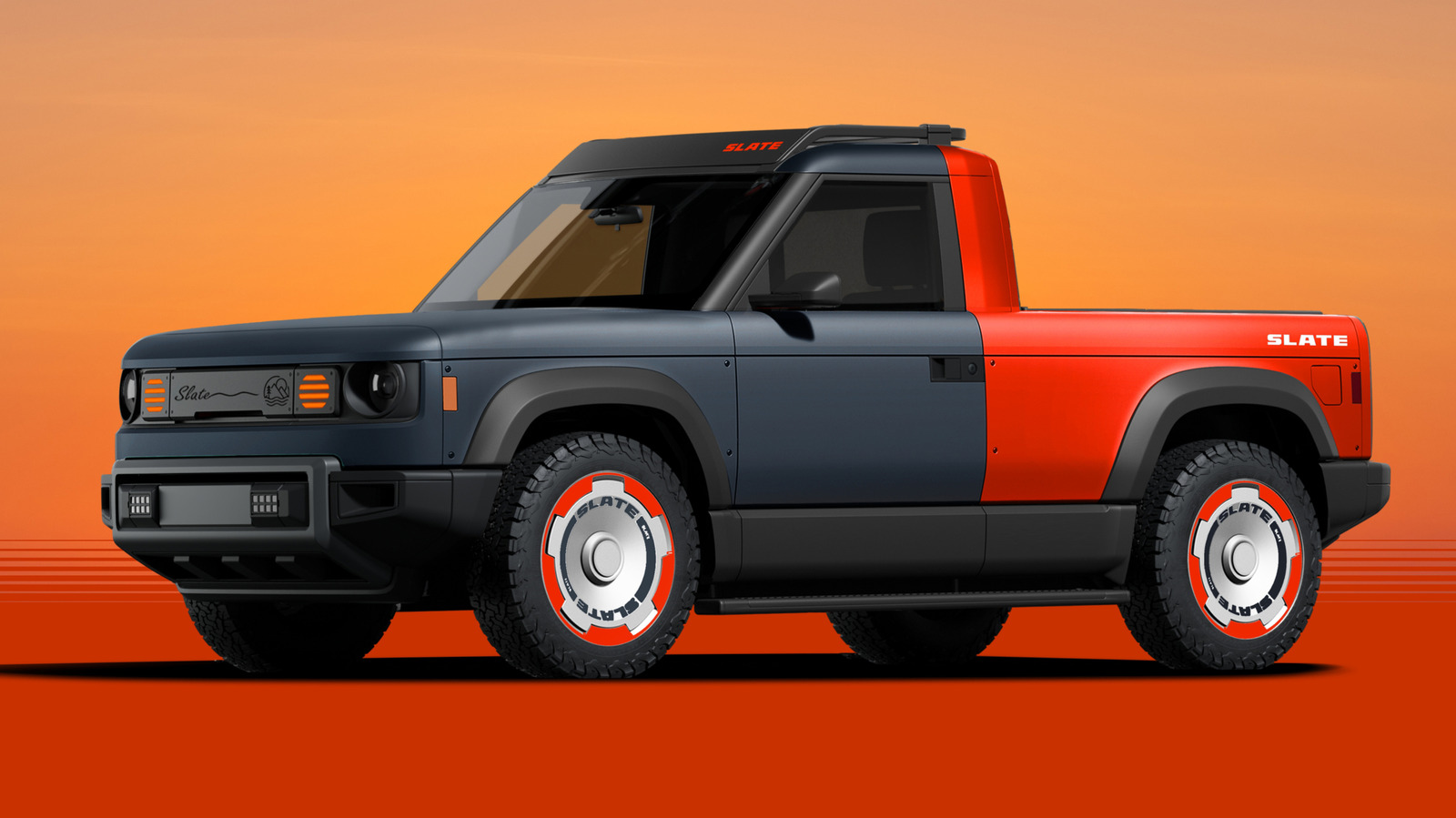
Where the Slate is supposed to shine are the features (or lack thereof) and customization. Notably, the two-seater Slate can be modded into a two-row SUV or sportback design reminiscent of the old mini Chevy K5 Blazer or a mini vintage Ford Bronco. Those options, of course, add to the price ($29,950 for the SUV and $31,950 for the fastback).
The base model Slate has almost no features to speak of, putting it roughly in front of a Toyota pickup from 1996 in terms of creature comforts. You don’t even get a radio in base trim. Features like armrests and the ability to pair your phone can all be added for extra money.
The Slate also comes in one color, that is the color of slate. Interesting for an automaker, Slate encourages drivers to wrap their mini trucks and the configurator on the website offers a few options. This is reminiscent of the early days of motoring where, to keep costs down, automakers would only offer a few paint colors from the factory. Tesla operates under a similar structure when it comes to exterior paint.
Positively niche
The total lack of features and low starting price definitely has its appeal to two distinct groups of people: internet car enthusiasts who pine for simpler cars without as much infotainment or touchscreen-powered noise in a car (like me), and companies who need a fleet of cheap trucks that are easier to maintain and prepare for company livery than gas-powered trucks. The latter market, I suspect, will turn out to be the main focus of Slate’s sales goals.
Is the Slate EV cool? Yes. Is it inexpensive? Comparatively, yes (though delivery fees are still yet to be announced). Will anyone apart from delivery companies or contracting firms buy it in large enough numbers? That remains to be seen, and I am not convinced the simplicity will appeal to a large enough swathe of non-fleet buyers to make a dent in sales of rival models, electric or otherwise.
A used Chevy Bolt, Nissan Leaf, or Hyundai Ioniq 5 has the potential to be less expensive, offer more range, and have exponentially more features than the base model Slate. It’s important to remember that crank windows and no radio (paired with a mediocre 205 mile range) makes the Slate positively niche in terms of market appeal.
